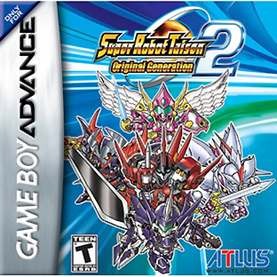
 USA
USA
Super Robot Taisen: Original Generation 2
Description
Super Robot Taisen: Original Generation 2 (GBA, 2005 JP/2006-2007 NA): Tactical role-playing game developed by Banpresto for Game Boy Advance. Japan February 3, 2005, North America November 14, 2006 (some sources cite May 2007). Second Super Robot Wars/Taisen series entry officially released outside Japan after predecessor's historic Western debut. Direct sequel to Super Robot Taisen: Original Generation both story and gameplay—continues Original Generation sub-franchise featuring exclusively Banpresto's original characters/mechs with zero licensed anime properties.
Story: Set six months after Divine Crusaders War and L5 Campaign conclusion (Original Generation ending). Earth Federation Army announces alien existence publicly via Tokyo Manifest, implements Aegis Plan mass-producing Personal Troopers and new mechs defending against extraterrestrial threats. Divine Crusaders remnants remain at large opposing Federation. Multiple mysterious forces mobilizing: Inspectors—renewed extraterrestrial assault surpassing Aerogaters' power; Shadow Mirror—unknown force whose mobile weapon numbers/power exceeds realistic possibility; Neo DC—Divine Crusaders remnants seeking military state establishment (many ex-DC officers leading); Einst—monstrous entities with shrouded origins/purpose. Heroes confronting multiple enemy factions simultaneously—each with competing agendas, temporary alliances masking betrayal plans.
Narrative structure: Removed predecessor's dual protagonist route selection system—replaced with single linear storyline featuring three individual route splits where protagonists temporarily divide forces accomplishing multiple simultaneous objectives. Focuses on plots from Super Robot Wars 3 (SNES 1993), Super Robot Wars Advance (GBA 2001), Super Robot Wars Impact (PS2 2002), with elements from Super Robot Wars Alpha Gaiden. Total four new series added (three past Super Robot Wars games, one manga: Chōkijin Ryūkoō Denki). Introduces characters/mechs from aforementioned games plus protagonists/mechs from Alpha 1 and 2nd Super Robot Wars Alpha. All Original Generation 1 stages considered canon except Kyosuke route chapters 32-Final—clarifying continuity for sequel. Storyline complexity: Unlike predecessor's two-half structure (first half Divine Crusaders war from Super Robot Wars 2, second half Aerogaters from Shin/Alpha 1), Original Generation 2 interweaves all storylines simultaneously—new/old characters interacting, multiple enemy groups with conflicting agendas working together while planning backstabbing. Complex political intrigue mixing personal stories valor/sacrifice. Significantly darker tone, mature themes, convoluted plot criticized by some, praised by others for ambition.
Gameplay improvements: Base mechanics identical to Original Generation—turn-based SRPG, Spirit Commands, Will/Morale gains. Chain Attack skill—most significant addition allowing pilots with skill attacking adjacent enemies using weapons marked (c), up to four depending skill level. Especially useful bypassing Support Defense abilities. Ace Bonus system expansion—pilots achieving 50 kills gain unique character-specific bonuses beyond previous games' simple +5 starting Will. Examples: Ryusei gains +10% damage bonus for Telekinesis-required weapons, Kyosuke gains +10% melee weapon damage plus Counter skill activation rate increase, Masaki gains +5% all damage plus +10% accuracy. Full Upgrade Bonus system expansion—fully upgrading all mech stats (excluding weapons) grants custom preset bonuses per unit versus previous games' player-selected generic stat boosts. Custom Ace/Full Upgrade Bonuses increase personalization, distinguish pilots/mechs without cheapening challenge. Difficulty increase: Significantly tougher than Original Generation. Increased boss-class enemy encounters, greater numbers, forced scenarios with small predetermined unit selections—sometimes without upgrade/equipment opportunities beforehand. Not unfair—Battle Mastery completionists challenged but careful resource management and enduring early-stage difficulty rewards extremely fun long-run experience. Replay value improved—New Game+ mechanics enhanced.
Interface/Animation: Redesigned user interface improving navigation/clarity. Longer, more elaborate battle animations capturing mecha combat intensity—though still lacking damage/evasion animations (recoil-only upon hits). Visual quality extremely good for GBA standards. Detailed sprite work, polished special effects, impressive presentation.
Music quality: Double-edged sword versus predecessor. Many more songs—chiptune versions of Alpha 2 music, new Advance music arrangements. Downside: music quality less clean than Original Generation or Advance—likely memory space issues. Some arrangements surpassed originals (Viletta theme, Chaos variant preferred over PS2 version by some), others suffered compression. Technical improvements: music assignment system allowing players selecting background music per unit (mech-based or pilot-based)—reducing overexposure to specific tracks or assigning favorites universally. Sound test unlocked in New Game+ addressing Original Generation's omission. Expanded music selection pool in subsequent playthroughs.
Sales: Specific figures unavailable but sold sufficiently justifying sequel development and PS2 remake inclusion. Less commercially dominant than first game but respectable performance continuing franchise momentum.
Critical reception: No aggregate Metacritic score. Enthusiast reviews extremely positive—RPGFan praised as massive improvement over Original Generation, acknowledging steep learning curve but "rockin' good time" for strategy RPG fans. Went from "pretty good" (OG1) to "this is a blast" (OG2). Complex story with unresolved plot points compelling players toward importing Japan-exclusive sequels. Praised: intertwined storylines, character interactions, multiple enemy factions, strategic depth, customization improvements, difficulty balancing (challenging but fair), expanded Battle Mastery system. Criticism: overwhelming story complexity (too many factions/plot threads simultaneously), music quality downgrade from predecessor, continued lack damage/evasion animations, increased difficulty potentially frustrating casual players.
Length: 26.5 hours main story focus, 113 hours 100% completion—massive content for handheld SRPG. 54 playable scenarios providing extensive tactical variety. Completionists pursuing all Battle Mastery objectives, secret unit acquisition requirements (complex multi-stage conditions), pilot skill optimization spending 100+ hours.
Legacy: Cemented Original Generation as viable standalone franchise separate from main Super Robot Wars. Final GBA entry before franchise transitioned to PS2 with Original Generations remake June 27, 2007 (Japan-only)—combined Original Generation 1 + 2 with enhanced graphics, voice acting, additional scenarios, Twin Battle System enabling squad-based combat. Original Generations established definitive Original Generation continuity, retconning GBA games' exact plotlines while preserving core narrative.
Multimedia expansion: Super Robot Wars Original Generation: The Animation OVA (takes place after Original Generation 2's events)—animated adaptation expanding universe. Further sequels: Super Robot Wars Original Generation Gaiden (PS2 2007 Japan-only), The 2nd Super Robot Wars Original Generation (PS3 2012 Japan-only), Super Robot Wars Original Generation: The Moon Dwellers (PS4/PS3 2016 Japan, PS4 2017 English-language Asia release).
Historical significance: Proved Western viability of complex Japanese tactical RPGs without anime licensing. Demonstrated sequel could meaningfully expand scope/systems without alienating fanbase. Successfully balanced accessibility (English localization) with hardcore depth (sophisticated mechanics). Established template for ambitious handheld sequels—more content, improved systems, interconnected narratives rewarding series investment. Final opportunity Western players experiencing Original Generation GBA duology before franchise moved console-exclusive. Influenced subsequent tactical RPG design emphasizing customization depth, branching narratives, interconnected character arcs.
Enduring appeal: Cult classic among tactical RPG enthusiasts appreciating density/complexity. Often cited as superior to predecessor despite (or because of) increased difficulty. Players valuing intricate storylines, extensive customization, challenging strategic gameplay consider peak GBA tactical RPG experience alongside/above Fire Emblem, Final Fantasy Tactics Advance. Historical footnote as second/final Super Robot Wars Western release before decade-long localization drought (next Western release: Super Robot Wars OG Saga: Endless Frontier, DS 2009 North America-only). Demonstrated potential for Banpresto original-only content competing with licensed crossovers—legitimizing Original Generation as equal franchise pillar rather than spin-off.
What Members Paid (Anonymous)
No member purchase data available yet. Be the first to add this game to your transactions!
Shopping Assistant
Use our AI-powered shopping assistant to find Super Robot Taisen: Original Generation 2 across multiple online marketplaces including eBay, Mercari, Amazon, and more.