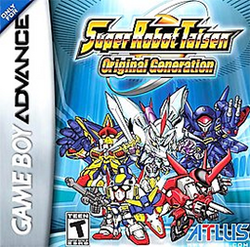
 USA
USA
Super Robot Taisen: Original Generation
Description
Super Robot Taisen: Original Generation (GBA, 2002 JP/2006 NA/EU): Tactical role-playing game developed by Banpresoft, published by Banpresto (Japan), Atlus (North America), 505 Games (Europe). Japan November 22, 2002, North America August 8, 2006, Europe 2006. First Super Robot Wars/Taisen series entry released outside Japan—historic milestone for long-running franchise dating to 1991 Game Boy. Revolutionary premise: first series entry featuring exclusively Banpresto's original characters/mecha created for previous Super Robot Wars games with zero licensed anime properties—solving decades-long licensing issues preventing Western releases.
Development/Background: Super Robot Wars flagship Banpresto franchise since 1991—crossover tactical RPGs combining licensed mecha anime series (Gundam, Mazinger Z, Getter Robo, etc.) into unified storylines. Japan's mecha craze since 1970s made series every anime fan's dream—piloting favorite robots together. Banpresto progressively developed original characters/mechs alongside licensed properties to populate games. Growing interest in originals plus extensive library prompted dedicated Original Generation series 2002—entirely Banpresto creations, no licensing complications enabling Western release. Atlus licensed both Original Generation games (OG1/OG2) for North America 2006—first series entries reaching West after 15-year Japan-exclusive history. 505 Games handled European publishing.
Story: Set Space Era year 179—200 years after humanity began space colonization. Two meteors destroyed much of Earth at 21st century start, sending civilization into chaos. Third meteor struck Marquesas Islands, South Pacific containing Extra-Over Technology (EOT)—advanced alien technology. Dr. Bian Zoldark investigating meteor discovered EOT creators (alien race Aerogaters) heading to Earth to reclaim technology. Earth Federal Government develops Personal Troopers—humanoid combat mecha—using EOT to defend against coming invasion. Aerogaters initially attack Earth investigation ship at solar system's far reaches—skirmish ends Aerogater defeat. Aerogaters sue for negotiations—talks arranged Antarctica secret facility. Rogue faction Divine Crusaders attacks negotiations, destroys Aerogater delegation, turns on Federation forces. Bian Zoldark reveals himself Divine Crusaders leader, announces Aerogater existence publicly, rebels against Earth Government plunging world into civil war. New Aerogater force mobilizes seeking lost EOT while Earth tears itself apart—dual-front war against civil insurrection and alien invasion.
Dual protagonist system: Player chooses between two male protagonists experiencing conflict from different fronts—Ryusei Date or Kyosuke Nanbu. Each route features unique missions, different party members encountered, distinct mechs piloted, separate scenarios. Routes share similarities but diverge significantly through mid-game. Eventually both protagonists' parties unite forming large combined cast with brief branching stages based on initial character choice. Chapters 23+ mostly unified regardless of chosen route, except Kyosuke's route chapters 32-Final differ significantly. Both routes required for complete story understanding. New Game+ unlocks after completing both routes—earned money and Pilot Points carry over to subsequent playthroughs with increasing percentages per completion.
Revolutionary weapon customization: Franchise first—players equip/remove weapons on mechs. Example: Plasma Saber equipped Weissritter removable, transplantable to R-1 for pilot utilization during sorties. System exclusively available Real-Type mechs (realistic military-style robots)—Super Robots (super-powered fictional machines) lack weapon swapping capability. Strategic depth customizing loadouts for specific mission requirements/pilot preferences.
Grid-based tactical combat: Turn-based strategy—player turn/enemy turn structure. Each unit: one movement, one attack per turn. Movement required before attacking (some attacks exclusively pre-movement). Killing enemies grants: experience points (pilot leveling), Pilot Points (PP—skill customization currency), Morale bonus (affects damage output/weapon availability), money. Losing units: repair cost penalty enforced mission completion, unit unavailable remainder of stage. Units upgrade two ways: mech stat enhancement, weapon upgrades/swaps. Pilot customization via PP purchasing skills: Assist Attack (offensive support), Assist Defend (defensive substitution), SP Up (Spirit Points increase), Genius (accuracy/evasion/critical rate improvements), Fighting Heart (+5 starting morale), many others. Sophisticated skill trees enabling deep character builds.
Spirit Commands (Seishin)—special pilot abilities consuming SP (Spirit Points): Accelerate (movement boost), Focus (accuracy/evasion boost), Strike (guaranteed hit), Alert (guaranteed dodge), Fury (damage increase), others. Strategic SP management crucial mission success. Morale/Will system—dynamic stat affecting combat effectiveness: increases via kills/damage dealt, decreases via damage suffered. Higher morale unlocks powerful weapons, improves performance. Starts base value, modified by pilot skills like Fighting Heart. Battle Mastery system—optional objectives per mission (time limits, defeat counts, survival challenges). Completing Battle Mastery grants bonus rewards—skilled players aiming perfect playthrough.
Formation system organizes party positions affecting speed/defense/attack power. Chain Attack skill—advanced pilot ability attacking multiple adjacent enemies (up to four depending skill level), bypassing Support Defense abilities. Ace Bonus—pilots achieving 50 kills gain starting +5 Will bonus plus unique character-specific bonuses. Full Upgrade Bonus—fully upgrading all mech stats (excluding weapons) grants special enhancement. Support Attack/Defense—allied units within range assist attacks or defend teammates, adding tactical positioning considerations.
One-handed operation mode—GBA convenience feature enabling single-hand play. Cover attacks seal enemy counterattacks when properly executed. Cover attack/defense actions increase power through repeated use. Characters exchange status points and special skills—party synergy mechanics.
Music/Sound: No voice acting—text-only dialogue (acceptable for 2002 GBA standards). Enjoyable soundtrack fitting scenes—many characters possess unique battle themes adding personality/variety. Manly characters receive manly songs, quirky characters get quirky themes. Minor characters share themes—GBA cartridge space limitations. High-quality MIDI music impressing despite hardware constraints. Weak sound effects—lasers/missiles/guns sound appropriate but lack "oomph" on impact, choppy animations degrading attack satisfaction. Technical GBA limits make effects sound cheap despite proper execution. Individual character themes enhance personality understanding.
Graphics: Detailed sprite work—each mech/character brimming with personality, intricate design. Battle animations notable capturing intensity/scale of mecha combat—explosions, laser beams, special attacks rendered with polish/dynamism bringing pixels to life. Art direction heavily sci-fi/mechanical aesthetic ensuring environment/character design cohesion. Menus/UI crafted with care contributing immersion. Animation quality impressive for GBA though lacking damage/evasion animations—units simply recoil when hit rather than animated reactions (addressed in later entries). Visuals extremely good for GBA hardware.
Sales: Japan 2002: 171,343 copies—ranked #73 top-selling games year (Famitsu). Sold well in Japan justifying sequel production. North American/European sales figures unavailable but sufficient for Atlus green-lighting Original Generation 2 localization.
Critical reception: No Metacritic score (insufficient reviews). RPGFan praised as great introduction for new players—"awesome enough" Atlus bringing taste of long-running series. Noted refined gameplay from 15+ years franchise experience—significantly better than early SNES entries. Acknowledged not everyone's cup of tea—appeals primarily mech fans, strategy RPG enthusiasts (Fire Emblem, Final Fantasy Tactics Advance fans), import veterans replaying for translation. 30-50+ hours content (main story 30 hours, 100% completion 50 hours). Praised deep strategic gameplay, comprehensive combat system, numerous customizable mechs, solid fundamentals. Criticism: weak sound effect impact, repetitive minor character themes, absence damage/evasion animations, steep learning curve for series newcomers unfamiliar with complex systems.
Awards/Legacy: Broke Super Robot Wars Western barrier—first series entry after 15-year Japan exclusivity establishing franchise viability internationally. Demonstrated original-characters-only approach solving licensing nightmares plaguing crossover series. Spawned multimedia adaptations: Super Robot Wars Original Generation: The Animation OVA (takes place after Original Generation 2), Super Robot Wars Original Generation: Divine Wars TV anime (retells first game story—complete adaptation 26 episodes). PS2 remake Super Robot Wars Original Generations (2007 Japan-only)—combined Original Generation 1 + 2 with enhanced graphics, cinematic angles, new scenarios, additional robots, choice starting OG1 or OG2. Further sequels: Original Generation 2 (GBA February 2005 Japan, May 2007 North America), Original Generation Gaiden (PS2 2007 Japan-only), The 2nd Super Robot Wars Original Generation (PS3 2012 Japan-only), Super Robot Wars Original Generation: The Moon Dwellers (PS4/PS3 2016 Japan, PS4 2017 English-language Asia release).
Historical significance: Milestone breaking Super Robot Wars into Western markets after impossible licensing barriers. Proved franchise viability outside Japan when properly adapted—no anime knowledge required, self-contained story accessible to newcomers. Established Original Generation as enduring sub-franchise rivaling main series popularity in Japan. Demonstrated tactical RPG depth rivaling/exceeding Fire Emblem—sophisticated systems, extensive customization, meaningful choices. Introduced Western audiences to refined turn-based mecha strategy perfected through decade-plus iteration. Cultural impact: became gateway drug for Super Robot Wars fandom West—importers/enthusiasts previously alone suddenly joined by English-speaking community. Atlus's localization praised professional translation making complex systems understandable. Influenced Western perception Japanese tactical RPGs beyond Fire Emblem/Final Fantasy Tactics. Franchise continued strong Japan—dozens subsequent entries across platforms (GBA, DS, PSP, PS2, PS3, PS4, PS5, Switch), though only select titles received English releases (primarily Original Generation sub-series).
Enduring appeal: Cult following among tactical RPG enthusiasts appreciating deep systems, extensive customization, strategic complexity. Battle Mastery challenges provide replayability—completionists attempting perfect runs. Dual routes encourage multiple playthroughs experiencing different perspectives. New Game+ with carry-over progression rewards replays.
Considered among best GBA tactical RPGs alongside Fire Emblem, Final Fantasy Tactics Advance—distinct identity through mecha focus, sophisticated pilot/mech progression, unique combat systems. Still discussed recommendation for GBA SRPG enthusiasts seeking lengthy, challenging, rewarding experiences. Historical footnote as game that finally brought Super Robot Wars West after 15 years, opening doors for franchise's international expansion albeit limited by continued licensing complexities in main series.
What Members Paid (Anonymous)
No member purchase data available yet. Be the first to add this game to your transactions!
Shopping Assistant
Use our AI-powered shopping assistant to find Super Robot Taisen: Original Generation across multiple online marketplaces including eBay, Mercari, Amazon, and more.