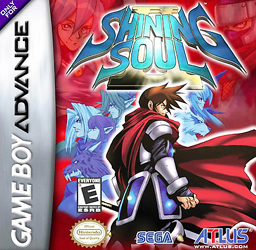
 USA
USA
Shining Soul II
Description
Shining Soul II (GBA, 2003-2004): Action role-playing dungeon crawler developed by Grasshopper Manufacture (Killer7, No More Heroes) and Nextech, published Sega/Atlus/THQ. Sequel to Shining Soul (2002), part of Shining series. Japan July 24, 2003 (Sega), North America April 20, 2004 (Atlus—originally scheduled February 24, 2004, delayed two months multiplayer stability testing/localization refinements), Europe March 26, 2004 (THQ—multiple language support English/French/German/Italian/Spanish). Japan released "Value Selection" budget re-release early 2006 (both Shining Soul games). Directed by Akira Ueda (former Squaresoft graphic designer—joined Grasshopper 1999). Junichiro Takahashi produced for Sega. Marked pivotal reboot Shining series—transitioning from tactical RPG roots (Shining Force) toward real-time action combat, part of "Shining Project" initiative after Sega exited hardware business.
Gameplay: Dungeon crawling hack and slash, playing similarly Diablo or Baldur's Gate: Dark Alliance. Top-down isometric perspective, real-time combat emphasizing dungeon exploration, equipment collecting, monster slaying. Ten dungeons tied into storyline, eight hidden dungeons to explore. Vastly improved over predecessor—fixed most problems plaguing original. Enemies no longer run blindly into extended swords. Dungeons showcase variety in design. Character animations have life and style. Graphics/animations vastly improved making this practically new game versus Shining Soul. "Feels a little bit like Zelda and has the depth of Diablo."
Eight playable character classes (double previous four)—can be improved up to level 200. Each customizable with variety of weapons, spells, support abilities, attributes. Different classes using same weapons attack differently—example: Warrior's spear attack thrust, Archer throws spear over distance. Each character equips up to three weapons/three items, switch between anytime. Additional three slots by equipping Backpack/Knapsack. Attacks performed tapping attack button, held to charge more powerful attack. Each usable spell has own spellbook—only classes with spell on skills list can use spellbook casting spell.
Character classes:
Warrior (Eric/Alex Japan): Balanced melee class. STR 16, DEX 14, INT 8, VIT 12, HP 42, SP 16. Equips swords/axes/spears/shields. Skills: Sword/Axe/Spear damage increase/charging, Shield reduces/blocks damage percentage, Armor Up increases equipment defense percentage, Critical Strike increases critical hit percentage, Efficiency reduces SP consumption, Berserker increases attack when HP drops below half (risky).
Archer (Rwinn/Luin Japan): Ranged specialist. Attacks from afar using bows/spears, summons forest creatures. Love range power—especially charged shots. Tactical retreats necessary. Relatively fast charge time while running makes nice kill-before-you-reach-me pace. Target one enemy at time (game likes mobbing). Enemies behind attacked enemy tend brought closer.
Sorceress (Premiera/Pamela Japan): Offensive elemental magic. Uses variety offensive elemental spells from distance. Blaze powerful spell (explosion long-range), Freeze successive hits, Spark stuns, Blast great boss killer (bad tight corridors), Inferno fire damage. Spells increase range with levels. Magic Shield parries/reduces damage.
Dragonute (Tyroth/Tiros Japan): Slowest but toughest melee class. STR 16, DEX 13, INT 5, VIT 16, HP 48, SP 10. Equips axes/flails/shields. Skills: Axe/Flail damage/charging, Shield/Armor Up defense, Break Armor lowers enemy defense with successful hits, Breath counters with breath attack, Weaken weakens nearby enemies, Magic Res increases magic resistance—probably best skill game (later enemies constantly use spells, 40 resistance everything). Similar Warrior but inferior weapons, doesn't have Efficiency, eats more healing items (trade-off not good), working Counter (not enough skill points—exponential). Longest reach with Flail.
Priestess (Prim): Healing/support specialist. Specializes healing/support spells. Rod for melee (short range single whack initially boring, actually versatile multiple builds). Heal cures status all skill levels, Shining Aura attack technique. More useful multiplayer.
Dark Wizard (Armand/Bloodstar Japan): Dark elemental magic. Demon Breath like poor man's Blaze. Venom poisons enemies, Darkness ring close-range, Morph changes into monster (tougher by level), Dagger Dance summons sword (set damage), Drain absorbs HP small percentage into health long-range, Meditate speeds SP recovery. Didn't seem as good compared Sorceress.
Brawler (Zachs/Sachs Japan): Most powerful and quick offensive melee class, suffers low defense. STR 16, DEX 16, INT 5, VIT 13, HP 39, SP 10. Martial arts type. Really effective with SP draining knife or constantly feeding SP items. Overpowered charge with impunity. Skills: Claw/Knife attacks (multiple hits), Stun chances/length, Counter (activated physical attacks only, single target), Guts increases damage when HP below half (requires healing up to trigger passive). Evade doesn't seem to do anything.
Ninja (Raizen): Swift medium-ranged class using mix of spells and physical attacks. STR 13, DEX 18, INT 7, VIT 12, HP 36, SP 14. Equips swords (melee)/knives (long-range). Skills: Sword/Knife damage/charging (charged Sword repels enemies, Knife charged shot spread/normal autoaims), Critical Strike percentage, Debris causes falling object in front (levels increase range), Replace invisibility (doesn't prevent damage—game wasn't perfected preventing invincibility, very useless single player but VERY VERY VERY useful multiplayer—dueling Coliseum won't be seen other player screens, backstabbing, sometimes lowers damage taken dramatically), Backstab, Magic Res multiple enemies (lower chance initiating than Brawler's counter but targets multiple).
??? (Secret Character—Gelespie appearance): "Improved" Dark Wizard. Unlocked after beating game once. Similar Armand. No default name.
Advanced character mechanic—"Shining Force": Advanced characters may combine Force links forming Shining Force—formidable weapon destroying all but most powerful opponents.
Story: Fantasy world where ancient balance between light and darkness disrupted. Set many years after forces of Light banished forces of Darkness—veil of malevolence returned to land. Classic fantasy tale Good versus Evil. Skies filled dark clouds hiding sun yet shedding no life-giving rain drought-plagued plains. Terrible monsters began appearing threatening well-being all good people realm. King Marcel of Kingdom Klantol holds grand tournament at coliseum finding hero capable protecting country. Player tournament champion tasked vanquishing threats. Sorceress Dark Angel unleashes monsters, places legendary heroes under mind control turning against own people. Must rescue bewitched heroes, ultimately confront greater evil Chaos. Thick mysterious clouds formed overhead blocking sun but not releasing drop rain. Little connection storyline rest of series aside reference Shining Soul events introduction. However, alternate universe version Boken from Shining Force appears major NPC. Traditional Shining mascot Yogurt hidden in stages. Number dungeons from original Shining Soul appear short hidden dungeons. Possible find various classic Sega artifacts including past consoles—used as items communication.
Multiplayer—defining feature: Supports multiplayer via link cable (1 player single-player, 2-4 players link cable). Very similar Diablo's multiplayer. Run around dungeon attacking monsters in sight. Players can give items each other by throwing or dropping. Party only moves next area when every player character either passed exit point current area or died. Opening inventory window does not pause game (single-player or multiplayer)—some players reorganize inventory while others engage combat. Some classes more useful multiplayer (Priestess/Archer particularly valuable). Link-cabled multiplayer options available including trade items or compete head-to-head Royal Coliseum. Co-operative multiplayer game every bit thrilling GBA's "Four Swords"—hardcore but accessible. Multiplayer better than single-player. Replace skill (Ninja) extra effects multiplayer—won't be seen other player screens Coliseum duels.
No pause screen—game obviously hard, no pause doesn't help either. Must return town using Angel Wing or clear area enemies if needing pause. Death significant—group archers advance mode suddenly appear nowhere killing without noticing what shooting.
Length/difficulty: 10-30 hours completion time depending playstyle/grinding. Much more difficult experience than predecessor—extra challenge helps make considerably better game. Excessively difficult by today's standards—today's RPGs arm enemies with pillowy swords, heroes with one-hit-kill spells. Very dependent on grinding—repetitive fast. Melee characters must be ready anything. Level 4 weapons and level 8 spells appear Hard mode. Advance mode challenging—300 HP Ninja died instantly entering dungeon 100 HP (very humiliating dying second later). Incredible amount replay value willing tackle advanced difficulty or try different class through game. Eight character classes—possibilities multiplayer/replay endless. However, while alone, game loses bit steam. Stat point investment crucial: Magic Classes generally 3 Int/1 Vit, Melee Classes pump Str/Vit/Int to taste/Dex as needed. Try keeping HP & SP at/slightly over healing item values (HP 20/50/200, SP 30/100). Focus mostly 2-3 skills. Graphics: Bright colorful isometric 2D sprite-based visuals. Timeless beautiful graphics—simple graphic style. Fluid animations characters/enemies. Top-down isometric perspective evoking classic dungeon crawlers while optimizing GBA display/processing power. World absolutely interesting. Playable characters cool. Vastly improved graphics/animations make this practically new game.
Audio: Decent soundtrack. Voice acting minimal due hardware limitations—restricted occasional basic vocalizations NPCs, majority interactions conveyed text-based dialogue. Design includes series callbacks—audio nods mascot character Yogurt integrated certain shop/event sequences. SFX leverage system capabilities including pulse wave/noise channels sharp responsive feedback during action. Audio mixed optimize portable playback ensuring clarity through headphones or GBA built-in speakers. Slow-to-roll-out dialogue bogs down game beginning, pace quickens when fighting begins.
Reception: Metacritic 74% (based on 18 critic reviews—61% positive, 39% mixed, 0% negative). Famitsu 32/40 (Japan). Metacritic User Score 8.1 (based on 11 ratings—73% positive, 18% mixed, 9% negative). Netjak 90/100—"In generation games where developers put more time into cutscenes, talking, character development than pure gameplay, this hack/slash RPG huge relief. There's time and place games more like movies, but Shining Soul 2 reminder what hobby videogames all about." Nintendo Power 84/100—"Slow-to-roll-out dialogue bogs down game beginning, but pace quickens when fighting begins." Pocket Games 80/100—"With eight character classes possibilities multiplayer/replay endless." Game Informer 75/100—"Feels little bit like Zelda and has depth of Diablo. Not bad. Not bad at all." Inside Gamer Online 72/100—"Game obviously hard, fact there's no pause screen doesn't help either." GMR Magazine 70/100—"Vastly improved graphics/animations make this practically new game." AceGamez 50/100—"Shining Soul II suffers from very flawed combat system, leaving it open RPG veterans only."
Praise: Best Diablo-like game for GBA. Pure gameplay relief versus cutscene-heavy generation. Variety and customization—what people enjoy dungeon crawler genre, Shining Soul II offers both abundance. Single-player engaging/varied, multiplayer even better. Looking something little deeper than usual GBA fare. Timeless beautiful graphics. World absolutely interesting. Playable characters cool. Fixed most problems plagued original game. Dungeons showcase variety design. Character animations have life/style. Vastly improved. Solid gameplay enormous/fully customizable—"AFTER OVER 100 HOURS!!! Good Lord, game got addicting. Would stay up..." High gameplay value. Incredible replay value. Crowning glory co-operative multiplayer every bit thrilling GBA's "Four Swords." Hardcore but accessible. Feels little bit like Zelda depth of Diablo. Best GBA game. Worthy sequel overshadowing first game numerous ways. Solid understanding what makes good video game, takes interesting risks.
Criticism: Repetitive gameplay loop gets repetitive fast. Very dependent grinding. Doesn't convey important details game very well. Slow dialogue beginning. Obviously hard, no pause screen doesn't help. Flawed combat system leaving open RPG veterans only. Annoying item management. Single-player loses bit steam alone. Serious shortcomings. Niche experience. Too reliant level-grinding. Simply Shining Soul I in different box with bare bones plot added whereas first didn't.
Sales/collectibility: Initial sales Japan showed promise—peaked top tiers weekly charts shortly after July 2003 launch, failed sustain blockbuster momentum internationally. Positive word-of-mouth regarding multiplayer features helped drive adoption portable gamers—limited long-term longevity crowded market. Physical copies rare collectibles 2025: loose cartridges reselling $60-$80 secondary markets, complete-in-box versions fetching $110-$180, sealed examples up to $300-$360. No official digital re-release or emulation support available Sega or Atlus—restricting access primarily original hardware or unofficial means.
Marketing: Japan campaigns leaned established Shining series lore drawing existing players. Western promotions Atlus highlighted similarities Diablo broader appeal action RPG fans. Television commercial aired Japan promoting July 2003 launch underscoring sequel's enhanced class variety/real-time battles. Trade show demonstrations showcased co-op features, though no major tie-ins like bundles GBA link cables reported.
Legacy: Overshadowed predecessor Shining Soul (2002—mixed reviews, moderate sales). Shining Soul II expanded formula more classes, deeper storytelling, improved mechanics. Contributed revitalizing Shining series handheld platforms blending RPG elements fast-paced action compact format suited GBA. Sales contributed Grasshopper Manufacture's early reputation developer capable delivering innovative action-RPG experiences handheld platforms—paving way studio's subsequent high-profile titles like Killer7. Marked significant milestone Grasshopper—first project released internationally helping elevate studio's profile beyond domestic audiences. Diversifying portfolio action-oriented RPG under multiple directors including Akira Ueda, Grasshopper gained experience handling larger-scale productions contributing foundational skills used subsequent titles. Cult classic among GBA enthusiasts. Fans consider best Diablo-like GBA game, would love see remake Switch. Feels little makings cult classic—solid understanding what makes good video game, takes interesting risks, serious shortcomings.
Demonstrated handheld capable delivering complex Diablo-style dungeon crawler. Proved stealth mechanics beyond direct ports. Sustained player dedication—"100+ hours addicting." Ranks among deeper GBA fare. Series never officially continued beyond Shining Tears (PS2 2004), Lunar Knights (DS 2007 spiritual successor Boktai abandoning Shining branding). No sequel despite cult following. Remembered fondly those experienced full multiplayer experience—memorable link cable co-op sessions. Shining Soul series (including Shining Tears) distinct separate entity versus Shining Force tactical RPGs—people expecting something slightly reminiscent Shining Force guaranteed disappointed (not same thing, action RPGs much like Zelda).
What Members Paid (Anonymous)
No member purchase data available yet. Be the first to add this game to your transactions!
Shopping Assistant
Use our AI-powered shopping assistant to find Shining Soul II across multiple online marketplaces including eBay, Mercari, Amazon, and more.