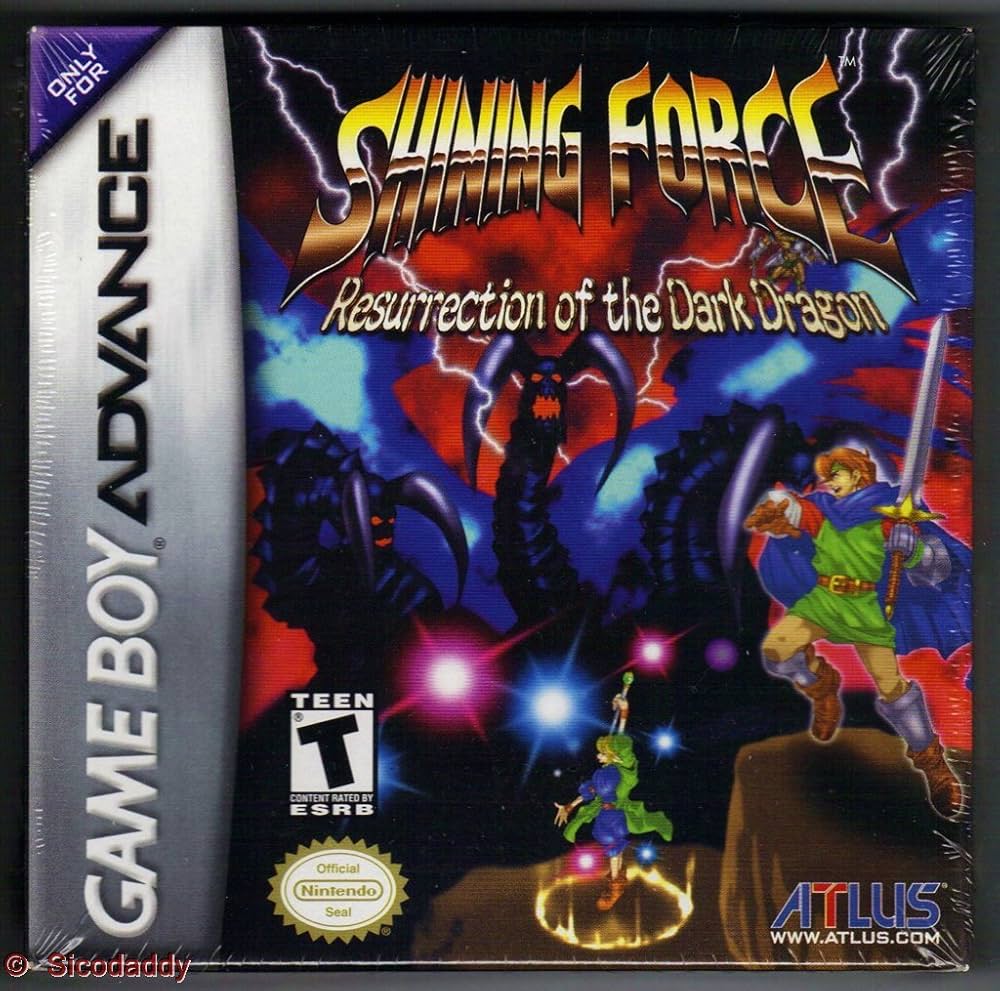
 USA
USA
Shining Force: Resurrection of the Dark Dragon
Description
Shining Force: Resurrection of the Dark Dragon (GBA, 2004 EU/NA/JP): Turn-based tactical role-playing game developed by Amusement Vision (later restructured into Ryu Ga Gotoku Studio/Yakuza dev) and Climax Entertainment for Game Boy Advance. Enhanced remake of Shining Force: The Legacy of Great Intention (Sega Genesis/Mega Drive 1992-1993)—second entry Shining series, first tactical RPG installment. Europe April 30, 2004 (published THQ), North America June 8, 2004 (published Atlus), Japan August 5, 2004 as Shining Force: Kuroki Ryū no Fukkatsu (published Sega). Third Shining series title reaching GBA after Shining Soul series.
Development: Collaboration between Amusement Vision and Climax Entertainment. Saw return of original series artist Yoshitaka Tamaki and writer Masaki Wachi, who developed new script with expanded narrative featuring additional characters. Composer Masahiko Yoshimura's fantasy-sci-fi soundtrack adapted from Genesis original. Project aimed preserving Genesis classic's spirit while modernizing for handheld generation.
Story: Kingdom of Guardiana in land of Rune—peaceful fantasy world containing science fiction elements. Protagonist Max—young warrior with total amnesia washed ashore in Guardiana, remembering nothing from past. Mysterious traveler Darksol befriends King Ramladu of Runefaust while secretly planning resurrection of ancient terrible Dark Dragon—powerful evil monster sealed away by gods long ago. Enemy commander Kane leading Runefaust hordes attempting opening Shining Path to resurrect Dark Dragon. Max sent on mission preventing Kane and Dark Dragon's return. Along journey, recruits diverse allies forming Shining Force—army defending kingdom from evil. Eventually discovers both Kane and King Ramladu controlled by manipulative Darksol.
GBA enhancements over Genesis original: Three new playable characters—Mawlock, Narsha, Zuika (total 33 characters versus Genesis's 30). Brand new subplot: Narsha, disillusioned princess of Runefaust, story interspliced with Max's journey introducing three new characters. Narsha's narrative shows events in Runefaust whenever Max wins battles—alternate perspective expansion. Friendship mechanic—party members conversable revealing personal stories with Max. Conversations improve relationships, some required unlocking personal character cards. Unique Card System—card-collecting subquest where Narsha (new character) equips found cards transforming into characters/monsters depicted. Some cards damage entire enemy army before first move—significant tactical addition. Cards obtained through NPC conversations, exploration, completing objectives. Character's knockout prevents obtaining their card/backstory—adds challenge/frustration depending perspective.
Ramping difficulty system (New Game+ star system)—revolutionary replay mechanic: every successful playthrough completion earns star, all enemies receive stat boost next playthrough. Can accumulate multiple stars (hardcore players achieving 99-star runs documented). Carries over collected cards between playthroughs. Makes initially moderate-difficulty game progressively challenging—completionists facing brutal difficulty spikes. Turn order transparency—determined solely by unit's Speed stat, checkable anytime via list allowing precise battle planning (Genesis used Speed plus random seed). Character stat rebalancing—eliminated particularly overwhelming/overly weak units from Genesis version, though community debates success (Mawlock/Narsha controversially powerful, some Genesis favorites weakened). Updated localization—professional translation versus Genesis version.
Graphics/presentation: Redrawn character portraits matching SNES aesthetic, redesigned battle poses, visual effects upgraded for spells/attacks. Smoother, less pixelated than Genesis. Town/map environments solid approximations—some mountain/forest textures intentionally repeat like Genesis (nice touch). Movement no longer grid-restricted in towns/overworld—speeding travel considerably versus Genesis's grid-locked movement. Battle maps/villages use similar blue/green/purple/gray tile hues as Genesis—deliberately preserving 16-bit aesthetic though appearing plain versus GBA-native titles. Side-view battle backdrops/attack animations lively, inspired, retouched but less sharp than Fire Emblem contemporaries. Battle animations polarizing—different from Genesis's distinctive style. Some Genesis animations considered superior (Max's attack downgraded, magic effects less impressive). Others appreciated GBA smoothness.
Audio: Masahiko Yoshimura's compositions identical Genesis originals—cozy town theme, rousing battle song, ominous ruins dirge. Instantly recognizable though not staying with players forever. Quality contentious: Genesis described "tinny, metallic," GBA described "muffled, like listening from outside room"—different platforms produce different aural experiences of same compositions. Music operatic, memorable—testament 8-bit Genesis sound chip capabilities but developers didn't clean scratchiness/hissing from original soundtrack. Battle sounds generic, score criticized for not rousing fighting spirit. Best experienced via headphones/external speakers versus GBA's weak speaker. Enthusiasts praised orchestral pieces.
Gameplay mechanics: Turn-based tactical RPG—battles on square grids, each unit occupying one square. Player controls maximum 12 fighters selected from growing roster (30+ total recruitable characters). CPU fields 30+ individual units per battlefield. Unit moves up to fixed squares determined by Move statistic. Depending position relative enemies/allies, unit performs one action: attack, cast spell, use item, search area. Some commands (equipping/dropping items) don't count as actions. Each allied unit represented by character with own background/personality—no generic units (Fire Emblem-style). Most characters contribute little/nothing to plot upon joining. Each unit possesses class defining abilities, accessible spells/equipment. Experience gained damaging/defeating enemies—units level up. Promotion system—units promote to advanced classes at specific levels. Death not permanent—fallen characters resurrectable post-battle for fee (unlike Fire Emblem permadeath). Allows training weak characters despite knockout risk, though affects card collection.
Exploration mode—Japanese-style traditional RPG between battles. Max represents entire army walking around, interacting with people, finding treasure, buying equipment/items, outfitting army, choosing battle participants. No labyrinths, few puzzles—streamlined versus dungeon crawlers. Visit towns for information/shopping, explore world map finding hidden characters. Eight chapters containing 40+ different battles—battles take hour+ each when including prebattle setup. Total 40+ hours playing time (26 hours typical completion including optional battles/grinding, 40 hours completionist).
Character diversity celebrated: Flying warrior birds (Balbaroy and others), kooky inventor/aviator, steampunk mech fighter (Adam), floating jellyfish creature (Jogurt egg-hatchable), buglike assassin (Kokichi), baby dragon (Bleu/Deis), centaurs (cavalry), standard mages/archers/warriors. Character development strategic puzzle—some start weak but level robustly (potential diamonds), others start strong but fall behind (early carries), some remain weak throughout (Jogurt notorious joke character). Creates party-building trade-offs and replay variety testing different team compositions.
Sales: Specific figures unavailable. Sufficient commercial success justifying Sega/Atlus localization efforts. Not blockbuster but respectable performance cult classic.
Critical reception: Metacritic 77% (based on 20 critic reviews—75% positive, 25% mixed, 0% negative), GameRankings similar. IGN 8.5/10—"must-have for strategy RPG fans." GameSpot 8.2/10 plus Best GBA Game of July 2004 award—"great way to experience one of best tactical RPGs from 16-bit era," "one of best strategy RPGs on Game Boy Advance," "too good to pass up." Electronic Gaming Monthly 78/100—praised improved visuals, new battles, top-notch updated localization but criticized terrible battle animations. Game Informer 7.5/10—nostalgic but noted games cherished in 1990s don't necessarily stack up against modern juggernauts. More enjoyable as nostalgia than fresh experience given Final Fantasy Tactics Advance competition. Play Magazine 83/100—"becomes completely absorbing through world, characters, thoughtful gameplay." HonestGamers 8.0/10—praised strategy element rarity, distinct controls, easily-followed storyline, well-thought-out score, trend-setting GBA graphics. RPGFan—mostly successful remake preserving original's spirit despite odd additions. Cubed3—proved classics acceptable today, holds own surprisingly well against Fire Emblem/Final Fantasy Tactics Advance.
Praise: Solid traditional tactical RPG fundamentals—accessible yet strategic, lengthy quest, diverse character roster, strong replay value via New Game+ star system. Card collection system innovative if polarizing. Friendship mechanic adding character depth. Rebalanced gameplay. Professional localization. Faithful Genesis preservation introducing classic to new generation. Pure, timeless gameplay/level design/pacing. Portable convenience. 40+ battles providing substantial content. Party customization freedom. Turn order transparency enabling precise planning. Easy-to-learn interface. Fun challenging battles.
Criticism: Graphics/audio not utilizing GBA capabilities—16-bit presentation standards versus contemporary GBA-native titles. Visuals plain, tiles look Genesis-like rather than modern. Battle animations different/inferior to Genesis originals in some cases. Sound scratchy/hissing, music muffled. Battle sounds generic. Story fails drawing in casual players—formulaic light fantasy despite hidden depth. Lacks tactical depth versus Fire Emblem/Final Fantasy Tactics Advance—simpler mechanics. First playthrough not terribly hard (unlike brutal New Game+ difficulties). Grinding optional battles can get redundant. Some new additions conflict with original's spirit—purist fans disliked changes. Card mechanic/new characters (especially Zuika/Narsha) controversial. Bleu's stats nerfed in remake. Balance issues despite rebalancing attempts. World changes not fitting Shining Force lore according to some fans.
Legacy: Demonstrated viability bringing Genesis tactical RPG classics portably—successfully modernized 1992 game for 2004 handheld market. Proved Shining Force franchise still relevant competing against Fire Emblem/Final Fantasy Tactics Advance dominance. Established template for respectful 16-bit remakes balancing preservation with enhancements. Introduced Western audiences to Shining series beyond Shining Soul action-RPGs. Star difficulty system influenced roguelike/replay-focused design. Card collection mechanic experimental addition showing willingness innovate beyond straight port.
Historical significance: Third Shining series GBA title but first tactical RPG entry (Shining Soul/Shining Soul II were action-RPGs). One of best tactical RPGs available on GBA—frequently recommended alongside Fire Emblem series, Final Fantasy Tactics Advance, Advance Wars series, Tactics Ogre: The Knight of Lodis. Maintained Shining Force's legacy as one of earliest/most influential console tactical RPGs (1992 Genesis original predated Fire Emblem's Western debut). Amusement Vision's successful remake before restructuring into Yakuza franchise developer. Atlus's continued support niche tactical RPGs Western market.
Enduring appeal: Cult classic among tactical RPG enthusiasts and Genesis nostalgia fans. Debate continues among Shining Force community whether remake surpasses/equals/inferior to Genesis original—divisive among purists appreciating changes versus traditionalists preferring 1992 version. Accessibility (permanent death absence, resurrection system) makes approachable for tactical RPG newcomers intimidated by Fire Emblem permadeath. New Game+ star system provides hardcore challenge rivaling/exceeding Fire Emblem difficulty for completionists. Character variety/party customization freedom ensuring high replayability. Frequently cited as underappreciated GBA gem—overshadowed by Fire Emblem/Final Fantasy Tactics Advance but offering distinct identity through fantasy-sci-fi blend, simpler-yet-engaging mechanics, character-driven narrative. Gateway introducing players to broader Shining franchise. Testament to timeless quality Climax Entertainment's original design—12 years later, core gameplay remained pure and enjoyable. Preserved accessibility to Genesis classic for players lacking retro hardware—modernized while respecting source material's spirit.
Re-releases: iOS version 2010 (discontinued 2015 by Sega). No Virtual Console or modern platform releases unlike Genesis original (Genesis version available Wii Virtual Console, Steam, Sonic's Ultimate Genesis Collection, Nintendo Classics service 2021).
What Members Paid (Anonymous)
No member purchase data available yet. Be the first to add this game to your transactions!
Shopping Assistant
Use our AI-powered shopping assistant to find Shining Force: Resurrection of the Dark Dragon across multiple online marketplaces including eBay, Mercari, Amazon, and more.