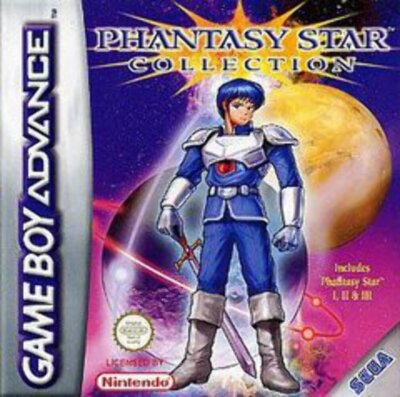
 USA
USA
Phantasy Star Collection
Description
Phantasy Star Collection (GBA, 2002-2003): Compilation of classic sci-fi RPGs developed by Digital Eclipse, published THQ (North America), Sega (Europe). North America November 24, 2002, Europe 2003. Part distribution deal between THQ and Sega including Altered Beast, Revenge of Shinobi. Features first three main entries Sega's Phantasy Star series: Phantasy Star (originally Sega Master System 1987), Phantasy Star II (Sega Genesis/Mega Drive 1989), Phantasy Star III: Generations of Doom (Genesis 1990). Created and co-developed by Sega, supervised by Overworks (Reiko Kodama keeping watchful eye on her babies, alongside Tohru Yoshida and End of the Millennium programmer Yoshiaki Endo). Games virtually identical original versions—opposed enhanced remakes. Phantasy Star IV: The End of the Millennium NOT included—most criticized omission (possibly best series, "better than III," apparently didn't fit onto 24-meg cartridge).
Phantasy Star series rivalry context: Before RPG market became big, two really popular RPG series each with faithful following—Sega had Phantasy Star, Nintendo had Final Fantasy. Name sends shivers through spines all experienced series Sega Master System/Genesis consoles. Widely considered rival Square Enix's Final Fantasy series. Revolutionized genre immersive 3-D dungeons, huge environments, hours gameplay.
GBA version technical approach—straight ports: Direct emulation preserving original ROM data. Tweaked games fit within GBA screen resolution. Resized graphics, smaller fonts, centered cut-scene text, full-screen display better utilize handheld resolution. Unified button controls across all three games easier navigation. Gameplay not altered. Reduced number save slots available Phantasy Star/Phantasy Star II versus originals. Does not include any extras—no unlockable goodies, video commercials, art galleries, bonus content (Saturn version had extensive extras). Music/sound effects "tinny as listening someone speak with two tin cans and string quarter mile long"—GBA perfectly capable producing orchestral-sounding music (Golden Sun proves this) but Phantasy Star Collection doesn't deliver expected quality. Something altered sounding horrendous when coming from GBA speaker. Doesn't sound "exactly" same. Battery backup saving progress each three games.
Improved English translation—significant enhancement: Improved English translation for original Phantasy Star fixes errors from Master System version—notable improvement though still using "horrible translations" original games overall. Grammatical errors persist.
Critical technical issues—infamous bugs: "Huge crash bugs" complained about IGN. Phantasy Star I save glitch BAD—actually causes whole game crash, game data isn't saved. Don't lose game completely, just start from prior save. Infrequent crashes just before saving game PS1—annoying but never critical as bug not frequent (since can save anywhere, anytime, not huge nuisance). Happened at least once players even when not far. Very rare but frustrating. Defense bug in Phantasy Star I never fixed—faithful ports lack simple fixes may have resolved issues still haunting series. Games aren't very portable—mazes PS2 complex as any game, still require lots grinding. Resolution cuts down view.
Phantasy Star (1987): Takes place Space Century 342, Camineet on Palmas—one of three planets Algol Solar System Andromeda galaxy. As Alis Landale, defeat King Lassic and evil his reign brought galaxy. Party of three travel vast Algo Solar System battling Lassic's minions with myriad weapons, magical spells, armor. Revolutionary for 1988—graphics amazing time, very colorful clear sprites, music very catchy never got tired hearing themes. Revolutionary its time—most RPGs during that time feature "save the princess" plot, this features very different story. Features one of first female protagonists in game. Features first-person perspectives, 3D effect for dungeons—pseudo-3D dungeons far ahead its time, think Quake. Players travel between different worlds. Battle system extremely easy learn, lots strategy involved. Characters different weapons—some hit just one enemy, others hit all enemies on screen. Choices affect what happens—talk people certain way, either help or attack you. These differences set game apart competed other RPGs released during time period, brings fresh twist genre. Eight-bit game. Battle animations decent. Characters average one and half times size average town!
Phantasy Star II (1989): Takes place Algo Solar System—around sun three planets Palm, Mota, Dezo. Mota saddest history. Planet Mota facing danger once again. Unknown evil overtaking planet—everything affected, climate, machinery, even nature. Tells legend Alis (from first game), brave young woman fought vanquished malevolent King Lassic. Many years passed, new evil lurking even worse than king. Every day many people killed strange creatures inhabit entire world. As Rolf, must unlock mystery behind dark force, restore peace planet. Party of three become outlaw, travel distant planet, battle monsters epic journey. Little bit longer employs more strategy than first title, continues few hundred years after first. Battles still turn-based, this time characters choose whom attack instead random. Offers more enemies on screen than original, pseudo-3D dungeons gone. Annoyingly long confusing dungeons—advice: be patient, have good memory or good pen/paper mapping way through them. Many extremely long dungeons transverse, some contain traps infuriating players (nothing make want stop playing). Often considered best of series—one best storylines, plot progressions series. Joyous music happy world beginning slowly replaced sinister songs advancing through game, fitting mood tragedy nicely. Filled memorable songs remember long time after playing. Still one best RPGs can find—lots characters, items, weapons, armor, places visit, hours finish. Battle system found PS2 still seen from time modern RPGs. 16-bit game. Battle animations decent.
Phantasy Star III: Generations of Doom (1990): Black sheep of series—everyone seems hate. Really strays formula set other two games, many other RPGs. Starts marriage ceremony—Rhys's ceremony marrying mysterious Maia, young woman found shores his kingdom. Dark Forces still remain. Conquer monstrous mutations. Fight swords, knives, bow, even wits embarking journey so vast spawns three generations. Trek through 7 distant lands reach one of four surprise endings. Instead just playing one main character entire game, gamers play through three generations characters—decisions made previous generation affect next. Depending choices people marry, different character play, slightly different storyline, one of four endings. Near end learn great evil occurs every thousand years around Algo star system, finally solve mystery big evil faced PS1/PS2 but couldn't know whom facing. Graphics pretty though feeling bit "washed-out" compared other PS games, more repetitive lack originality found PS1. Looks lot more like traditional medieval game like first Final Fantasys at first, becomes much more technological after while, linking PS3 to PS2/1 in style if not substance. Battles less animated than PS2 even PS1—battle animations nonexistent. Music still best heard Genesis, good with GBA. 16-bit game.
Story interconnection—series strength: Story interconnects between one Phantasy Star game next. Example: Phantasy Star 1 start planet Palma, Phantasy Star 2 destroy planet Palma, then Phantasy Star 4 return rubble planet fight old reincarnated enemy from first game. Notice changes one game to next. Although each game collections feature different characters/stories, take place Algol planetary system—specifically planets Palma, Motavia, Dezolis. Four games exists Dark Force—common antagonist threatening planetary system. Games make small references each other (idolation Alis in Phantasy Star IV).
Gameplay overview—traditional turn-based combat: Players explore futuristic worlds overhead view, party members following single file behind lead character entering buildings, talking residents, journeying new areas. Battles automatically segue third-person view positioned just behind party members' shoulders spreading horizontal line. Enemies appear distance atop blue grid set against black background simulate 3D perspective. Magic and melee weapons used traditional turn-based fashion against one/more alien creatures at time. Traditional RPG standard, style, superb design. Games considered bit slow today's standards, require quite bit grinding (leveling up before entering dungeons) but overall very well balanced. Dungeons frustrating mainly due designs. Much like Tetris, unrivaled depth—just getting through all consume hundreds hours.
Length: Bare minimum 50 hours all three games. 100+ hours pure RPG bliss over three games (some say 50-75 hours). Simply hasn't been Game Boy Advance game with this much gameplay to date (at 2002 release). Consume hundreds hours getting through all. Fantastic albeit amazingly difficult games. Games probably much too difficult/slow-paced today's gamer. Be prepared for challenge.
Value proposition: Three RPG classics on one cartridge can't be beat. All three games originally retailed about $70 each—total $210 original retail. GBA version sold under $30 (cool $20 Toys 'R Us). Huge bang for buck old-timers or newbies. No longer need Genesis with Power Base Converter playing original Phantasy Star. Price part three alone eBay probably more than pay this new. Hard complain getting two classics (and "PSIII") such bargain price. Quick fix between 50-75 hours gameplay under $30—as long don't mind wading through repetitious gameplay for pretty decent stories, can't beat value title. Graphics: Obviously dated compared other GBA RPGs (Golden Sun). Fairly obvious all three games collection look dated—compared GBA RPGs show age. Fourteen years after release first Phantasy Star Sega Master System, graphics games come long way. Viewed devoid nostalgic mist, earliest installments feel little more than average. Since pack presents games original versions, production values improve as go from first game to third. Overworld maps standard fare. Package filled value and historic charm.
Reception: Metacritic 76% (based on 20 critic reviews—65% positive, 35% mixed, 0% negative). Metacritic User Score 8.5 (based on 4 ratings—50% positive, 50% mixed, 0% negative). Nintendojo 93/100—"With most gameplay single title Game Boy Advance, hard pass title up. If fan RPGs, obviously MUST have this title." GMR Magazine 90/100—"Fantastic (albeit amazingly difficult) games every RPG should experience." Nintendophiles 85/100—"Phantasy Star Collection can last over 100+ hours pure RPG bliss over three games." Game Over Online 78/100—"I've already seen done before—quite possibly done better." Nintendo Power 74/100—"Since pack presents games original versions, production values improve as go from first game to third." IGN 60/100—"Quick fix gives between 50-75 hours gameplay under $30, as long don't mind wading through repetitious gameplay for pretty decent stories, just can't beat value title." GameCritics 55/100—"Phantasy Star games classic RPGs (yes, even third one...which everyone seems hate), they deserved at least little updating." Runner-up GameSpot's annual "Best Role-Playing Game on Game Boy Advance" award (went Tactics Ogre: Knight of Lodis).
Praise: Most enjoyable RPGs GBA. Triple fun, triple games, triple EVERYTHING. Extremely good, very underappreciated compared games like Final Fantasy. For all ages—don't listen people say only 80s generation can enjoy (19 year old enjoys everything about game). Music very catchy. Revolutionary its time. One of first female protagonists. First-person perspectives, 3D effect dungeons. Highly recommend picking collection up—Sega fan, Phantasy Star fan, GBA fan, fan good/classic RPGs general. Awesome game. Nice game, awesome pick, really enjoyed. Works, looks great. Best compilation titles hit GBA yet. Perfect system port older games from Sega Genesis/Super Nintendo. Playing original Phantasy Star on go appealing. Portability cancels out quirks/complaints. Three classic RPGs need played again by experienced first time, discovered by didn't. GBA made these types releases. More than enough adventure fans genre. One best RPG series played—simple reason notice changes one game next. Phantasy Star series beloved Sega staple, precursor many ways modern Final Fantasy series. Old school RPGs encompass first 3 games series. Great game wanting see roots series or want huge burst nostalgia. Games all intact original music/gameplay mechanics.
Criticism: Quality project less than titillating, virtually nothing changed—even used horrible translations original games. Sega involvement minimal best, skeptical exactly how much input Sega had. Digital Eclipse didn't do anything for ports—tinny music, grammatical errors, huge crash bugs. Simple cash run not serious effort bring franchise into new millennium. Unfortunate—Xerox-tastic ports, crash bug, inclusion unlockable goodies would've made collection so much better. Saturn version had video commercials, art galleries, sorts great stuff—GBA nothing. Games deserved at least little updating. Faithful ports lack simple fixes may resolved issues still haunting series—particularly defense bug Phantasy Star I. I've seen done before, quite possibly done better. For fans original games only. Package filled value/historic charm but viewed devoid nostalgic mist, earliest installments feel little more than average. Not flawless. Tinny as listening someone speak two tin cans/string quarter mile long. GBA perfectly capable producing orchestral music (Golden Sun) but Phantasy Star Collection doesn't deliver expected quality. Games all intact but considered bit slow today's standards. Dungeons frustrating mainly due designs. Repetitious gameplay. Too difficult/slow-paced today's gamer.
Other versions: Sega Saturn version (Japan April 2, 1998—part Sega Ages line)—exclusive Japan, includes ALL FOUR TITLES (including Phantasy Star IV), multiple save slots per game (up to four PS IV versus original two), options boost walking/battle speeds, adjustable text speed, minor graphical upscaling, widescreen display compatibility, interface entirely Japanese no English localization, video commercials, art galleries, extras. Modest commercial performance challenging period console (Saturn faced intense competition Sony PlayStation). PlayStation 2 version (Japan March 27, 2008—"Sega Ages 2500 Series Vol. 32: Phantasy Star Complete Collection")—includes Phantasy Star II Text Adventures series (released exclusively Sega Meganet network), two Game Gear titles (Phantasy Star Gaiden, Phantasy Star Adventure), all four main series titles, extensive options altering games visually/gameplay, can change machine type/localization (Japanese version/English localized counterparts). Limited sales ~20,000 units globally. Both versions far superior GBA version. PlayStation Network release for PlayStation available. PSP Genesis Collection includes Phantasy Star II-IV (missing PS I) with savestates making more portable experience.
Legacy: Classic RPGs preserved handheld format. Three pieces history. Contributions reviving interest pioneering sci-fi RPG elements—3D dungeons, narrative continuity across generations. Played key role preserving Phantasy Star series' legacy. Most portable gamers appreciated convenience playing legendary RPGs on go even with technical shortcomings. Fans series definitely pleased results. Price alone ($20-30 versus $210 original) made worthwhile purchase nostalgic players, newcomers curious about series roots. Demonstrated value classic compilations GBA—growing trend combine more than one game port giving players more bang for buck. Allowed finally experiencing first Phantasy Star (often missing other compilations). Story interconnection across games major draw. Best GBA game GBA made for these types releases—more than enough adventure genre fans despite straight-port approach. Recommended: Sega fans, Phantasy Star fans, GBA owners, classic RPG enthusiasts, players seeking massive gameplay value, those willing tolerate dated mechanics/bugs for historic significance. Cautioned: those expecting updated graphics/sound, players averse grinding/slow pacing, those wanting Phantasy Star IV (buy Genesis/Saturn/PS2 version instead).
What Members Paid (Anonymous)
Recent Purchases
Shopping Assistant
Use our AI-powered shopping assistant to find Phantasy Star Collection across multiple online marketplaces including eBay, Mercari, Amazon, and more.