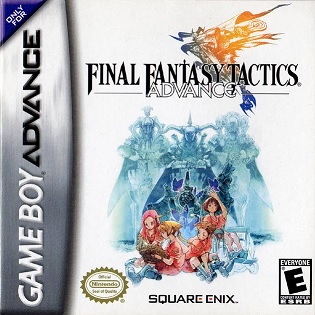
 USA
USA
Final Fantasy Tactics Advance
Description
Released in Japan on February 14, 2003 and North America on September 8, 2003 for Game Boy Advance, Final Fantasy Tactics Advance is a tactical RPG developed by Square and published by Square in Japan and Nintendo internationally. As a successor to the acclaimed Final Fantasy Tactics (1997), it was one of Square's final publications before its 2003 merger with Enix. The game represents a significant departure from its PlayStation predecessor in tone and mechanics while maintaining the core tactical gameplay.
Story and Setting
The narrative follows Marche Radiuju, a young boy who recently moved to the small town of St. Ivalice with his family. Along with friends Mewt (a timid boy frequently bullied) and Ritz (an academically gifted but socially isolated student), Marche discovers an ancient magical book. The book transforms their mundane world into the fantasy realm of Ivalice, complete with magic, monsters, and different races. While his friends embrace this new reality as an escape from their troubled lives, Marche seeks a way to return everyone home. Players command Marche's clan through over 300 missions as they navigate the political and personal conflicts of this transformed world.
Judge and Law System
Tactics Advance's most distinctive and controversial feature is its Judge and Law system. Every battle is supervised by a Judge riding an armored chocobo who enforces randomly changing laws that restrict specific actions—banning certain weapon types, magic elements, or combat maneuvers. Breaking laws results in penalties: Yellow Cards for first violations and Red Cards (immediate removal from battle and imprisonment) for repeat offenses or violations that result in enemy KOs. If protagonist Marche receives a Red Card, it's instant Game Over.
Players earn Judge Points by performing recommended actions (often the opposite of forbidden ones), which enable powerful combo attacks and summons. Later, players gain access to Law Cards that can add or remove restrictions, providing strategic control over battlefield rules. Special lawless zones called Jagds exist where no Judge presides, but fallen units who aren't revived by battle's end are permanently lost.
The system divided players—some appreciated the added strategic layer requiring adaptive tactics, while others found it restrictive and frustrating, particularly when multiple contradictory laws made battles nearly impossible without specific Law Cards.
Job and Race System
The game features five distinct races—humans, nu mou, bangaa, viera, and moogle—each with unique stat distributions and exclusive job classes. Players can field up to 25 clan members, customizing their abilities through an equipment-based learning system where characters master skills by using specific gear in battle. This creates deep strategic possibilities for party composition and development.
Development and Reception
Producer Yasumi Matsuno confirmed development in March 2002 when the game was 30% complete. Composer Hitoshi Sakimoto led the musical score with contributions from Kaori Ohkoshi, Ayako Saso, and series veteran Nobuo Uematsu. A two-disc soundtrack released in February 2003 featured both GBA and orchestrated versions. The game launched alongside a special white GBA console in Japan and was heavily promoted through a radio drama featuring voice actors Yuka Imai, Asami Sanada, and Yumi Kakazu.
Localization was handled by Alexander O. Smith (Vagrant Story) and incorporated fixes addressing Japanese player feedback. The game sold over 224,000 units in its first week in Japan, reaching second place in sales charts.
Reception was generally positive but mixed compared to the PlayStation original. Critics praised the charming art direction, refined mechanics, better pacing, and the five-race job system. However, many faulted the lighter, more childish story compared to the original's mature political drama, the divisive Law system, and equipment-based skill learning. The game was easier to exploit and lacked the narrative depth that made Final Fantasy Tactics a masterpiece, though it remained enjoyable on its own merits. The game was re-released on Wii U Virtual Console in 2016 and spawned a 2007 Nintendo DS sequel, Final Fantasy Tactics A2.
What Members Paid (Anonymous)
No member purchase data available yet. Be the first to add this game to your transactions!
Shopping Assistant
Use our AI-powered shopping assistant to find Final Fantasy Tactics Advance across multiple online marketplaces including eBay, Mercari, Amazon, and more.