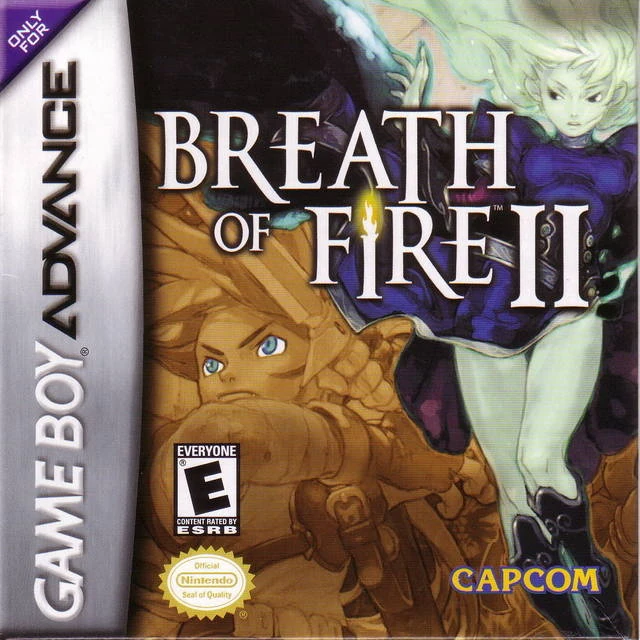
 USA
USA
Breath of Fire II
Description
Breath of Fire II (GBA, 2001 JP/2002 NA/EU): Turn-based JRPG developed and published by Capcom, originally for Super Nintendo Entertainment System (Japan December 2, 1994, North America December 1995). European SNES release April 1996 via Laguna. GBA port released Japan December 21, 2001, North America April 15-17, 2002, Europe June 28, 2002 via Ubisoft. Second entry in Breath of Fire series. Direct sequel to Breath of Fire set 500 years later. Produced by Tokuro Fujiwara, character designs by Tatsuya Yoshikawa (who also provided artwork for first game). Music composed entirely by series newcomer Yuko Takehara. Unlike first game's Square Soft localization, Capcom USA handled English translation/publishing exclusively.
Announcement: Three days before original Breath of Fire's GBA release in July 2001, Capcom announced Breath of Fire II port with initial 2002 release window. January 2002 Capcom USA confirmed North American April 2002 release. December 2001 Capcom Japan held fan art contest featuring characters from first two Breath of Fire games—winner chosen by GBA version's staff celebrating Japanese launch. Story: Protagonist Ryu Bateson, 16-year-old orphan member of elusive Dragon Clan possessing dragon transformation abilities. Works as "Ranger" (sword-for-hire). Begins in village of Gate where father Ganer serves as priest of St. Eva—seemingly benevolent deity whose teachings spread across land. Mysterious incident causes father and sister Yua to vanish, all townspeople forget Ryu's existence. Sets out to find missing family, uncover conspiracy behind St. Eva religion, discover connection to ancient Dragon Clan. Journey reveals dark religious themes rare for Western-released RPGs. Mature narrative involving false gods, religious manipulation, personal identity, memory erasure. Plot praised for subtlety—slow buildup revealing ominous forces at work.
Nine playable characters join party at set story points: Bow (ranger/thief), Katt (feline warrior), Rand (armadillo warrior), Nina (winged princess/mage with black wings—sister of Mina), Sten (monkey trickster/con artist), Jean (frog martial artist), Spar (plant creature), Aspara (mushroom creature). Each possesses unique attacks, magic spells, Personal Actions for field puzzle-solving/obstacle navigation. Maximum four active party members at given time—switching limited to certain areas unlike predecessor's free swapping.
Innovative gameplay systems: Township building—major feature allowing players to populate personal village with special NPCs found throughout world. Three carpenters with distinct building styles available for constructing houses via currency donation. Special characters invited to occupy houses provide various services (shops, item storage, mini-games). Choices permanent once made—optimal township planning requires strategic NPC selection. Six elemental Shamans recruitable: Sana (Fire—mandatory), Spoo (Wind—mandatory), Seso (Water), Solo (Earth), Seny (Holy), Shin (Devil). Shamans permanently missable if not discovered during specific story windows.
Shaman Fusion System—revolutionary mechanic allowing party members fusing with up to two shamans simultaneously. Fusion results vary by compatibility: failed fusion (incompatible pairing), enhanced base form (same appearance, boosted stats), advanced transformation (entirely new form, increased power, unique abilities). Each shaman boosts specific stat 25%: Sana (Attack via Strength), Seso (Wisdom capped at 255), Spoo (Vigor via Agility), Solo (Defense via Stamina), Shin (AP), Seny (no bonus alone but enables powerful dual-shaman combinations). Fusion temporarily removed if character reaches critical HP, knocked unconscious, or zombified—major strategic limitation forcing careful HP management. Characters lose field abilities when fused—some members must remain unfused for progression. System praised for depth but criticized for impermanence.
Dragon transformation redesigned from predecessor—Ryu's transformations now consume all AP for single devastating attack versus sustained form. Each character features unique Special Command abilities (e.g., Ryu's "Guts" self-healing with diminishing returns upon repeated use). Formation system allows party positioning affecting speed/defense/attack power. Turn-based combat ordered by agility ratings. Random encounters with high encounter rate—frequent criticism across reviews.
GBA port enhancements: Re-drawn character portraits matching Breath of Fire IV style, new still images for cutscenes, redesigned battle interface. Dash button enabling faster movement—revolutionary quality-of-life improvement over SNES's slow walking. Link cable item trading between cartridges. Three battery backup save slots. GBA version doubled all experience gains, tripled currency (Zenny) drops from SNES original addressing notorious grinding requirements. Translation unchanged from SNES—notorious for poor localization, lack of spacing in text fields, awkward dialogue. Capcom's decision not updating translation for GBA release widely criticized as missed opportunity.
Critical reception mostly positive—Metacritic 81%, GameRankings 75%. GamePro perfect score plus Editor's Choice Award—sole criticism low difficulty, declared "excellent time-killer" in realm of "high-powered next-gen role-players." Electronic Gaming Monthly four reviewers praised high-quality sound, lengthy quest, shaman mechanic. Three of four praised graphics; Mark Lefebvre dissented calling graphics below average, game "could have been a little better." GamePro's Major Mike impressed by sheer length—40+ hour quest. Praised complexity of main story/sidequests, graphics, musical theme changes midway through game. Summarized: "long, absorbing game offers plenty of story turns, intense battles, and intriguing characters."
IGN found game "step up from first game's GBA port"—"storyline and characters make Breath of Fire II much better game than first adventure...even though game hasn't changed a whole lot." Criticized lack of text spacing, "shoddy translation" hurting presentation, graphics inferior to GBA-native titles like Golden Sun. Ultimately called it "solid, enjoyable RPG experience...though not role-playing masterpiece on level of Final Fantasy VI or Chrono Trigger." Nintendo World Report praised hand-drawn sprite art over CG-style Golden Sun, bright varied color palette, high-quality sprites/backgrounds. Criticized dated audio, repetitive music after 30-40 hours, limited song variety. RPGFan acknowledged unchanged translation from SNES as "missed opportunity," criticized poor localization causing confusion determining next objectives. Praised 20+ hours solid role-playing action, recommended RPG fans add to library "warts and all."
Common criticisms: Unchanged poor translation from SNES (widely regarded among worst RPG localizations—grammatical errors, missing spaces, confusing dialogue making progression difficult without guides). High random encounter rate with lengthy attack animations creating slow-paced experience. Graphics outdated compared to GBA-native titles. Grinding requirements despite GBA's doubled experience/tripled money—original SNES version notoriously grindy. Repetitive music selections wearing thin during lengthy playtime. Shaman fusion impermanence—transformations undone too easily by low HP/knockouts. Township system fun but under-developed, permanent choices requiring guide consultation. Low difficulty according to some reviewers.
Praise consensus: Massive improvement over first game narratively, aesthetically, mechanically. Strong core cast with memorable party members (Katt, Deis frequently cited favorites). Township building innovative for era. Shaman fusion system deep, experimental, rewarding despite imperfection flaws. Mature religious themes refreshingly rare for Western RPG market. Lengthy quest (30-40+ hours main story). Solid traditional turn-based JRPG fundamentals. Dash button transformative quality-of-life feature for portable play. Formation system adding tactical depth. Excellent SNES-to-GBA conversion despite flaws.
Awards/nominations: GameSpot Best and Worst of 2002 Awards—nominated "Best Port of 16-bit Classic," nominated "Best Role-Playing Game on Game Boy Advance." Nintendo Power Top 200 Games (2006)—ranking unspecified but included.
Sales: No specific GBA sales figures publicly available. SNES version successful establishing franchise viability—sequel greenlit based on predecessor's performance.
Legacy: Established darker narrative tone adopted by later series entries. Township building/character customization through fusion systems influenced subsequent Breath of Fire games. Shaman fusion evolved into more refined transformation systems in Breath of Fire III/IV. Demonstrated RPG sequels could meaningfully expand scope/complexity within 16-bit constraints. GBA port proved viability bringing full-length SNES RPGs portably despite translation/audio limitations. Cult classic status among fans appreciating mature themes, strategic depth, ambitious scope. Frequently cited as superior to first game, preferred entry point for series newcomers despite translation issues.
Re-releases: Wii Virtual Console (North America August 27, 2007, Europe August 10, 2007), Wii U Virtual Console 2013, New Nintendo 3DS Virtual Console 2016, Nintendo Switch SNES library 2019. Virtual Console releases received mixed reception—GameSpot praised "pleasing visual presentation," breadth of content but called localization "terrible," unpolished mechanics appearing "hasty, careless effort," poor pacing with "mundane tasks," recommended only to players overlooking "rough edges."
Historical significance: Direct SNES sequel demonstrating Capcom's commitment to traditional RPG genre. Pioneering religious themes/moral complexity predating modern RPG narrative sophistication. Township building/fusion mechanics innovative for 1994 SNES release, influential on later customization-heavy RPGs. GBA port cemented Breath of Fire's handheld presence alongside original, establishing series' portable accessibility. Enduring fanbase appreciating ambitious design despite technical/localization shortcomings. Recognized as Capcom's boldest narrative experimentation in 16-bit RPG era, willingness tackling mature themes distinguishing it from contemporaries.
What Members Paid (Anonymous)
Recent Purchases
Shopping Assistant
Use our AI-powered shopping assistant to find Breath of Fire II across multiple online marketplaces including eBay, Mercari, Amazon, and more.