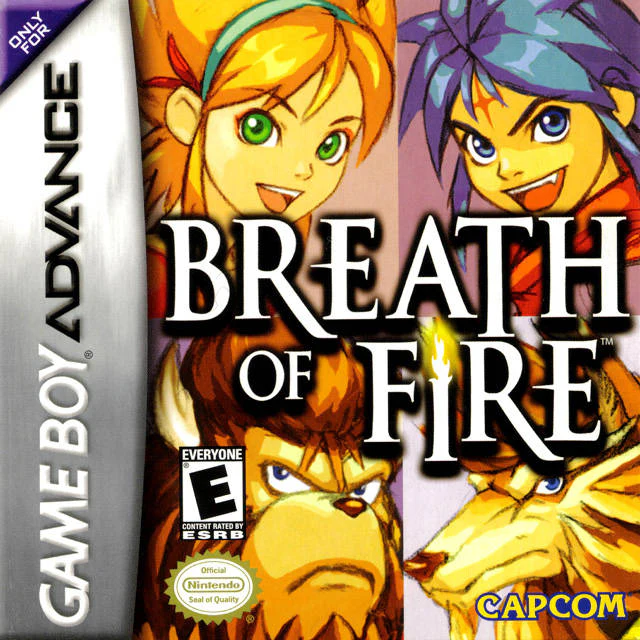
 USA
USA
Breath of Fire
Description
Breath of Fire (GBA, 2001 JP/NA/EU): Turn-based JRPG developed by Capcom, originally for Super Nintendo Entertainment System (Japan April 1993, North America August 1994). GBA port released 2001—Japan/North America December 13, 2001, Europe December 14, 2001. First entry in Breath of Fire series. Recognized by Capcom as their first traditional role-playing game establishing precedent for future entries. Original SNES version developed by designer Yoshinori Kawano, producer Tokuro Fujiwara (Ghosts 'n Goblins creator). Character designs by Keiji Inafune (credited as "Inafking")—Inafune's supervisor replaced him mid-development with Tatsuya Yoshikawa who retained Inafune's design features. Music by Capcom's in-house sound team Alph Lyla. SNES English localization/promotion handled by Square Soft due to Capcom USA's inexperience with text-heavy RPGs.
Story: Set fantasy world where dragon clans maintained peace for millennia through transformation abilities. Ancient goddess granting wishes splits clan into Dark Dragons and Light Dragons—conflict over goddess's power threatens world destruction. Light Dragon hero and seven companions seal goddess into alternate realm using six magical keys. Centuries later Dark Dragons seek keys to release goddess, destroying lands in search. Player controls Ryu—young member of nearly-extinct Light Dragon Clan, last surviving dragon warriors. Ryu searches for kidnapped sister while uncovering mysteries of his people. Classic hero's journey recruiting diverse party members: Nina (winged princess), Bo (wolf hunter), Karn/Gobi (merchant thief), Ox (blacksmith), Bleu/Deis (ancient sorceress), Mogu (mole engineer), Manillo (armadillo merchant). Battles Dark Dragon Clan militaristic empire seeking world domination.
Central gameplay mechanic: Dragon transformation system—Ryu's unique ability transforming into powerful dragon forms during battle. Multiple dragon forms unlocked throughout adventure with varying stats, elemental affinities, special attacks. Transformations consume AP (Agility Points) limiting strategic deployment. Classic turn-based combat—random encounters, front-view perspective, party up to four active members (eight total roster). Experience gain through combat, equipment upgrades, magic spells, item management. Field abilities for dungeon puzzle-solving—character-specific talents like Bo's hunting, Karn's thievery, Mogu's digging, Nina's flight.
GBA port enhancements announced March 2001—Capcom Japan touted new features, "intuitive" gameplay system. Graphical improvements: re-drawn character portraits matching Breath of Fire II style, redesigned menu interface replacing SNES's criticized clunky menus, updated cutscene graphics at key story moments. Quality-of-life additions: Quick Save feature allowing temporary save anywhere (deleted upon resume)—revolutionary for handheld RPGs enabling pause-anytime gameplay; Dash button enabling faster overworld movement eliminating slow walking tedium; Link cable item trading between two GBA cartridges with random bonus item rewards. Three battery backup save slots. Largely faithful pixel-perfect translation of SNES original preserving core gameplay, dungeon layouts, battle mechanics unchanged.
Capcom easter eggs: Chun-Li (Street Fighter) cameo appearance—NPC magician in Bleak town performs disappearing coin trick, refusing twice then accepting third attempt triggers Chun-Li practicing signature Lightning Kick. Also appears palette-swapped in certain endings.
March 2001 announcement preceded E3 2001 by two months. Capcom USA announced English version for September 2001 release. European release marked first time Breath of Fire available in Europe—SNES version never localized for region.
Sales performance Japan: Debuted third highest-selling game first week with 22,236 copies—GBA record at time. Total 63,407 copies sold Japan by end of 2001. Moderate commercial success compared to Golden Sun dominance but respectable for SNES port.
Critical reception generally positive—Metacritic 79%, GameRankings 76%. Electronic Gaming Monthly praised quick save feature declaring "BoF exemplifies hand-held role-playing done right." Game Informer recommended to "anyone who likes RPGs." Nintendo Power called it "excellent epic that still holds up." GameSpot acknowledged faithful SNES translation, "rock-solid game" offering "meaty challenge for RPG fans" despite not being "best-looking or most technically impressive RPG" on system. Noted music sounded "tinny" on GBA compared to SNES. IGN commented presentation "not much more than typical Japanese-style RPG," graphics outdone by GBA-specific titles, but solid overall. Play Magazine criticized port "flawed in execution"—high color saturation, lower sound quality versus SNES. GamePro found it "enjoyable RPG that easily kills spare time" but less involving than later series entries, narrative "lifeless." RPGFan enthusiastically declared "belongs in library of every Game Boy Advance owning RPG fan"—praised as nostalgic SNES-era experience portably accessible, recommended for both veterans and newcomers.
Common criticisms: Graphics/sound not utilizing GBA capabilities—pixel-perfect SNES translation meant 1993 presentation standards versus contemporary GBA titles like Golden Sun. Audio described as "tinny," "sparse"—battle theme particularly criticized as annoying. High color saturation making visuals overly bright. Narrative/pacing weak—minimal dialogue, repetitive scenarios, poor writing, lack of NPC depth. Unbalanced difficulty, steep learning curve. Linear structure limiting replay value beyond sidequests (fishing, hunting, optional character recruitment).
Praise consensus: Solid traditional JRPG fundamentals—lengthy 30+ hour quest, strategic dragon transformation system, party customization depth. Quick save revolutionary for portable play—legitimizing handheld as serious RPG platform. Menu redesign major improvement over SNES's clunky interface. Faithful translation preserving SNES classic for new generation. Strong foundation for Breath of Fire series establishing dragon transformation, party diversity, fantasy world-building traditions continued in sequels.
Awards: IGN Best of 2001 Awards—runner-up "Best Game Boy Advance Role-Playing Game" (lost to Golden Sun). Nintendo Power rankings: 82nd in Top 100 Nintendo games (1997), 161st in Top 200 (2006). Complex 2018: ranked 27th "Best Super Nintendo Games of All Time" (SNES version). IGN SNES Top 100: 43rd place.
Legacy: Launched Breath of Fire franchise spanning six mainline entries (1993-2016) plus spin-offs. Established series hallmarks: protagonists named Ryu with dragon powers, party member Nina, fantasy world-building mixing technology and magic, turn-based combat with transformation mechanics. GBA port demonstrated viability SNES RPG conversions for handheld—paved way for Final Fantasy, Fire Emblem, other SNES classics receiving GBA treatment. Proved quick save/dash features essential for portable RPG convenience—standards adopted by subsequent handheld RPGs.
Sequels/re-releases: Breath of Fire II (SNES 1994, GBA 2002)—direct sequel set 500 years later, also received GBA port with similar enhancements. Series continued PS1/PS2: Breath of Fire III (1997), IV (2000), Dragon Quarter (2002), plus mobile/online entries. Original Breath of Fire: New Nintendo 3DS Virtual Console 2016, Nintendo Switch SNES library 2019.
Historical significance: Capcom's first traditional RPG establishing company credibility in Square/Enix-dominated genre. SNES-to-GBA conversion template for preserving 16-bit classics portably. Dragon transformation system influenced later RPGs featuring morphing mechanics. Demonstrated handheld RPGs could offer console-quality experiences through thoughtful quality-of-life adaptations. Cultural impact: manga adaptations by Hiroshi Yakumo (two-volume Tokuma Shoten collection), solidifying multimedia franchise potential. Enduring cult following appreciating classic JRPG design philosophy—simple but effective mechanics, traditional fantasy storytelling, party-based strategic combat. Recognized foundational entry in beloved but now-dormant franchise, with GBA version serving as accessible entry point introducing Breath of Fire to wider European/handheld-focused audience.
What Members Paid (Anonymous)
Recent Purchases
Shopping Assistant
Use our AI-powered shopping assistant to find Breath of Fire across multiple online marketplaces including eBay, Mercari, Amazon, and more.