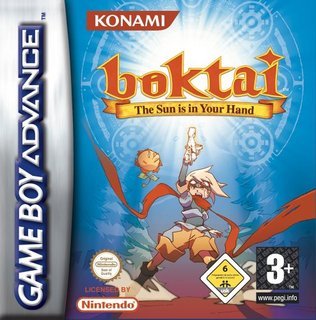
 USA
USA
Boktai: The Sun Is in Your Hand
Description
Boktai: The Sun Is in Your Hand (GBA, 2003): Action-adventure role-playing game developed by KCEJ (Kojima Productions), published by Konami. First game in Boktai series. Japan "Bokura no Taiyō" ("Our Sun"), abbreviated "Boktai". North America September 16, 2003. Produced and designed by Hideo Kojima (Metal Gear Solid creator)—first wholly original game for Nintendo hardware beyond Metal Gear: Ghost Babel (Game Boy Color 2000). Concept emerged right after Metal Gear Solid 2 development—Kojima's long-warehoused idea for "game that uses the sun somehow" plus desire to "make something weird." Originally planned stealth-based escape game beginning with player imprisoned, but planning couldn't work into satisfying experience. Pivoted entirely new vampire-hunting game with unprecedented solar sensor technology.
Revolutionary hardware feature—defining characteristic: GBA cartridge has built-in photometric light sensor measuring real sunlight exposure—first Game Boy Advance title using sunlight to influence gameplay. Cartridge housed in transparent case with large bulbous protrusion (approximately 1cm from GBA lip) containing black solar-sensing chip visible in circuitry. Sensor detects genuine UV rays only—flashlights/desk lamps cannot trick sensor (though UV lamps, black lights, plasma globes work). First portable game forcing players outdoors to play—revolutionary concept addressing original GBA screen's poor visibility (nightmare seeing properly indoors, required lamp behind or direct sunlight). Kojima figured "if life hands you lemons, make lemonade"—turned GBA's weakness into gameplay innovation. Sensor responds to player's environment, reflects solar energy amount in real-time. Strong sunlight charges quickly, weak sunlight charges slowly. Too much sunlight/heat causes gun overheating—must seek shade before continuing.
Setting: Age of Darkness—time period near world's end. Natural cycle of life and death broken. Undead creatures appeared after misuse of "Dark Matter" (type of energy corrupting/destroying life). People quickly died from Dark Matter use/misuse. Survivors became prey to dark creatures called "Immortals"—beings composed of Dark Matter at cellular level. World scorched, teeming with spiders, vampires, zombies, demons. Istrakan, City of Death—where many times/places intertwine, Django's destination preventing world's end.
Story: Play as Django (nicknamed "Solar Boy")—young vampire hunter with legendary vampire hunter blood running through veins. Son of Ringo (legendary vampire hunter who defeated King of Immortals using Solar Gun, magic machine handed down from Solar Children). Heir to Gun Del Sol (Solar Gun). Mission: rid world of Immortals, avenge father Ringo's death after killed by vampires. Named after coffin-dragging Spaghetti Western character "Django" (Franco Nero)—Boktai franchise presents several references to Spaghetti Westerns including Western-inspired music, archetypal characters. Accompanied by Master Otenko—sun spirit/sunflower-like character brimming with valuable advice, summons Pile Driver purification device. Django possesses solar blood allowing Gun Del Sol use. Hunting Count of Groundsoaking Blood (vampire killed Ringo), discovers Count just one of many Immortals. Must stop Immortals' plans traveling through Istrakan battling various undead. Brother Sabata ("Dark Boy") appears—initially antagonist under mind control.
Gun Del Sol mechanics: Legendary solar weapon firing bolts of sunlight at enemies. Composed four customizable parts obtained during game: lens (determines shot property, spread shot, attack power—higher level increases power/wider spread), frame (determines attack method/capability—examples include Gradius frame offering rapid shots named after Konami shoot-'em-up series, Beatmania frame firing loud-sounding shots named after Konami music game series), battery (energy tank—number of tanks varies by type), grenade (special supplementary ammo, different types with varying ranges). Some enemies/traps faced only with specific parts. Uses solar energy obtained from Solar Sensor. More energy = stronger weapon, but excessive energy causes overheating requiring cooldown wait. Gun Del Sol only usable by person with solar blood. Originally created by Smith (blacksmith from San Miguel) for Ringo, later passed to Django. Only weapon available first Boktai game.
Real-time clock/sun simulation system: Before starting, player prompted set current time and timezone. Game estimates when sun rises/sets, simulates sun position inside game. Django advantaged during daytime—vampires cannot be exposed to sunlight. Sunlight affects world around main character: Solar Trees (trees damaged by Immortals' darkness, cured by playing in sunlight), puddles dry up if exposed continuously, floating platforms/objects appear only when sunny, undead active during night stay quiet in dungeons during day. Outdoor environment includes bird chirp sound effects morning, soft orange glow around sunset. Playing at night makes monsters more powerful, Django weaker. Possible play portions at night by storing sun's energy ahead in Solar Stations (in-game recharge points)—if gun battery runs out with no sunlight available, must avoid enemy conflicts or find Solar Station. Strategic solar power conservation when facing tougher nighttime challenges. Old lairs have areas accessible only with items from later game—can revisit complete with/without sun.
Gameplay core: Isometric action-adventure with good mix combat, exploration, puzzle-solving. Stealth mechanics heavily influenced by Metal Gear—better sneaking behind/tricking enemies than winning everything with firefight. Django can press back to wall, knock on it creating diversion causing nearby enemies investigate. Certain blind creatures with acute hearing—only by sidling against wall can Django pass undetected. Stealth elements optional—rewarded for slipping through dungeons stealthily, but little need being deliberate without patience. Getting caught by monster (indicated red exclamation point above head) reduces grade received end-stage. Combat focuses shooting undead in back, stunning, then running away or killing. Dungeons filled with enemy encounters and puzzles—encounters themselves puzzle-like endeavor killing maximum without dying. Limited enemy variety (most palette-swapped), recycled bosses. Block-moving puzzles (overreliance—video game equivalent ready salted crisps). Inexplicable math puzzles—require solving equations by shoving components, weird/vaguely off-putting, game insults if asking help (criticized "I'm here to blast vampires dammit, not revise for GCSE maths"). Fiddly menus—boss fights constantly munching heals/speed/strength boosts requiring menu access each time (annoying). Grading system end-stages based on factors like stealth, time taken completing level.
Boss battles—Pile Driver purification unique mechanic: After dungeon levels reach "Immortal" level where one of four main bosses resides. Must fight way to boss creature (Immortal), defeat it. Two-phase boss fights: Traditional battle where Immortal unleashes special moves, tries knocking crap out of Django. After defeating boss in combat, Immortal sealed into coffin. Django must drag coffin via chain over shoulder back out of dungeon—usually using special escape routes set up by puzzles, taking slightly different path back. Coffins integrated into additional puzzles (using coffin as weight opening otherwise-impassable doors). Once outside, coffin placed on Pile Driver—circle of purification summoned by Otenko in front lawn each dungeon. Second boss fight "of sorts" occurs as player starts blasting foe with concentrated sunlight even as it desperately resists. Player must expose game to sunlight charging Pile Driver—greater sunlight amount, more damage Pile Driver inflicts upon Immortal. Strictly necessary direct sunlight performing purification process finally defeating main bosses. "Near-Victory Fanfare"—Pile Driver music gets steadily more epic as getting closer purifying boss. Impressive/memorable moments. Only way ensuring Immortal won't return after defeat—utterly annihilate dark power with Pile Driver. Deader than Dead mechanic. Cannot progress without sun cooperation—therein lies game's charm and vice (impediment to progress/annoying, but key to new/unique gameplay ideas).
Length/difficulty: Death slap on wrist—dying simply restarts room. Old lairs revisitable with later-game items. Moderately challenging—levels well-designed, enemy placement/movement paths add difficulty. Unless living sunny location, Boktai proves more challenging than other adventure games. Weather unpredictable/unreliable nature of sun (bad weather puts damper on slayer schedule)—even with skill ten Belmonts, if sun ain't on side, cannot progress.
Graphics: Bright colorful isometric visuals. Charming well-animated sprites. Creative dungeon designs. Gothic artwork blends perfectly with storyline/turn-of-century style setting (steampunk). Great use color palette—some stages change colors according to hour of day. Pretty damn good for GBA game released 2003. Solid graphics though some environment background elements shoddy. Distinguished from limited enemy variety.
Audio: Spaghetti Western-inspired music. Memorable tunes fitting atmosphere. Quite a few voiceovers—truly high production quality. Generic anime-style sound effects.
Reception: Metacritic 83% (based on 31 critic reviews—74% positive, 26% mixed, 0% negative). Famitsu 36/40 (Japan). GameSpot 85/100—"Boktai would be great game even if didn't have fancy solar sensor built right into cartridge. That just serves to make it even more interesting." Entertainment Weekly 100/100—"Sorry, shining flashlight about as effective as garlic against Dracula." Cheat Code Central 90/100—"Won't be disappointed with purchase unless live underground or perpetually overcast environment like England or Vancouver in winter." GamingTrend 87/100—"One of those gimmicky games that actually innovates rather than rely on gimmick alone." Play Magazine 83/100—"Playing game outside isn't something I feel affinity for, or even enjoy, but something I will do again, because Boktai game worth replaying." GMR Magazine 80/100—"Boktai finely fuses action with role-playing, well suited fans either camp." GameCritics 70/100—"Exposes what chronically under-explored medium portable gaming really is, demonstrates potential when creator given space indulge vision. Sure, unbalanced/at times inconvenient, but I'll take Boktai and games like it over Super Nintendo Entertainment System ports any day." Game Informer 50/100—"Innovative concept proves very frustrating in real life." Metacritic User Score 7.4 (based on 22 ratings—77% positive, 5% mixed, 18% negative).
Praise: Revolutionary innovative solar sensor mechanic—genuinely works, not mere gimmick. Strong game underneath without sensor. Unique gameplay ideas. Good mix combat/exploration/puzzle-solving. Stealth mechanics (though criticized step back from Ghost Babel). Bright colorful visuals. Creative concept. Charming characters. Encourages outdoor play/physical activity—first game doing so. High production quality. Voiceovers. Ranks among top GBA's extensive library. Excellent package—Konami shows more to vampire hunting than own Castlevania. Original/fun. Fall in love with characters/story. One of most innovative GBA games ever created. Strategic solar power conservation engaging. Playing equally fun at night.
Criticism: Solar sensor frustrating/annoying in real life—innovative concept proves very frustrating practically. Weather-dependent gameplay impediment to progress. Requires going outside (discouraging most video game players, especially those recognizing Hideo Kojima name).
Unpredictable/unreliable sun nature/bad weather puts damper on slayer schedule. Cannot progress if sun not cooperating. "Sun factor will drive you nuts." Obvious drawback—certain points if sun isn't shining, can't actually play. Generic anime garbage story—feels more approved by Kojima than actively designed. Stealth mechanics step back even from Ghost Babel Game Boy Color. Not much to do in-game. Limited enemy variety (most palette-swapped). Recycled bosses. Overreliance block-moving puzzles/ready salted crisps equivalent. Inexplicable math puzzles (insulting if asking help). Fiddly menus during boss fights. Some environment background elements shoddy. Control configuration cumbersome. Unbalanced/inconvenient at times. Mix between overly complex elements and overly simple ones. Cartridge expensive today (time not kind to delicate sensor—many damaged). "No type of gamer will enjoy it. Either will or won't."
Crossover content: Mega Man Battle Network series integration (starting Battle Network 4). Django and Otenko appeared Battle Network 4—sidequest where Django gets MegaMan help eliminate ShadeMan with Pile Driver (two large solar cannons shooting solar energy from front/behind target). After ShadeMan defeated, Django/Otenko spend remainder game in back "Dracky" ToyRobo outside Boktai exhibit Castillo. Gun Del Sol Battle Chip series—allows Mega Man use Django's iconic weapon (Battle Network 4-6, Rockman.EXE 4.5 Real Operation). Attacks with solar spread. Program Advance "Pile Driver"—formed using Gun Del Sol chips. Battle Network 5: Connecting with Boktai 2 makes CrossBattle mode appear—two players fight ShadeMan.EXE using BN5 and Boktai 2 battle styles. Battle Network 6: Sidequest with Django/Otenko (Japanese version—removed original English releases). Django Battle Chip attacks running over enemies with Coffin Bike. Program Advance "Crossover"—combining Django D/V2/V3 chips, Django appears back battlefield firing Gun Del Sol while MegaMan fires Buster, both perform cross-slash. Boktai series referenced more than once Mega Man Battle Network games (many players didn't learn until years later it was crossover, thought popular thing in that universe).
Sequels/series: Boktai 2: Solar Boy Django (GBA October 19, 2004)—Django loses Gun Del Sol to vampire, given Sol de Vice magical gauntlet, taught imbue melee weapons with solar energy. Later turned into vampire, loses ability but gains vampiric powers. Can switch between Human Django and Vampire Django. Melee combat with swords/spears/hammers. Expanding on what first game did every feasible way—peak of series according to fans. Shin Bokura no Taiyō: Gyakushū no Sabata / Boktai 3: Sabata's Counterattack (GBA Japan-only)—Django near death after betrayal by Sabata, kept barely alive due to vampire blood. Fully operational Gun Del Sol restored. Both GBA sequels employed solar sensor cartridges. Bokura no Taiyō: Django & Sabata / Lunar Knights (Nintendo DS)—name change attempt rebrand series after fourth game abandoned solar sensor (DS using cards instead of cartridges). Purifex Cannon—giant Pile Driver in orbit replacing original trilogy's ground-based version.
Multimedia: Manga "Solar Boy Django" produced Makoto Hijioka, published Shogakukan's CoroCoro Comic September 2003-July 2007. Loosely based on Boktai storyline. Does not follow plot directly though includes many characters (Count, Sabata). English version available from Singapore manga production company. 2007 Elex Media Komputindo licensed manga Indonesian market title "Jango the Solar Boy."
Development insights: Kojima longtime saying wants make "something weird." CD game where if player dies, disc itself breaks—wants something that weird (commercial disaster waiting happen). Metal Gear series always got prioritized over other projects. Game ideas piling up in head, warehoused future use—one hazy idea game using sun somehow. GBA came out more powerful than Super Famicom—handheld hardware getting really good. Similar sensor released to market—"if attach sensor to GBA cart, could work!" Official start everything. Konami often told ideas too crazy—dark times warm fan letters all that sustained him. Grown up alongside fans. Desire someday do something totally different. Really wanted work with Nintendo's hardware. Originally joined Konami develop Famicom or arcade games, somehow ended up MSX team. Boktai allowed creative freedom/indulge vision. Extremely weird advertising campaign suffered. Kojima wanted detect garlic breath sensor (wild idea never implemented).
Legacy: One of most innovative/unique GBA games ever—genuinely groundbreaking concept. First portable game encouraging outdoor play/physical activity—revolutionary 2003. Turned GBA's weakness (poor screen visibility) into gameplay innovation. Demonstrated potential when creator given space indulge vision. Under-explored medium portable gaming. Cult classic among GBA enthusiasts. Expensive collector's item today—original cartridges rare, delicate solar sensors fragile (time not kind), many damaged. Emulation requires patched versions simulating sunlight amount (defeats point of game but preserves playability). Ranks among GBA's best action-adventures despite polarizing solar requirement. Inspired nothing quite like it since—truly one-of-a-kind concept. Template blending real-world elements with gameplay (precedent AR/location-based gaming). Demonstrated Kojima's creative range beyond Metal Gear. Proved stealth mechanics viable handheld beyond direct Metal Gear ports. Metal Gear Solid meets Castlevania formula. Sustained Boktai series across four games despite niche appeal. Remembered fondly by those who experienced full outdoor gameplay—memorable lunchtime graveyard trips soaking UV rays blasting undead. Charm lies forcing players organize schedule around game, think like Immortal-hunter Django who must hunt by light of day. Perfect game for summer—get tan while playing GBA. Recommended: sunny climate residents, outdoor-tolerant players, Kojima fans, innovation appreciators, vampire hunting enthusiasts, collectors. Cautioned: overcast region residents (England, Vancouver winter), indoor-only gamers, those expecting Metal Gear-caliber stealth, weather-frustrated players.
What Members Paid (Anonymous)
No member purchase data available yet. Be the first to add this game to your transactions!
Shopping Assistant
Use our AI-powered shopping assistant to find Boktai: The Sun Is in Your Hand across multiple online marketplaces including eBay, Mercari, Amazon, and more.