 USA
USA
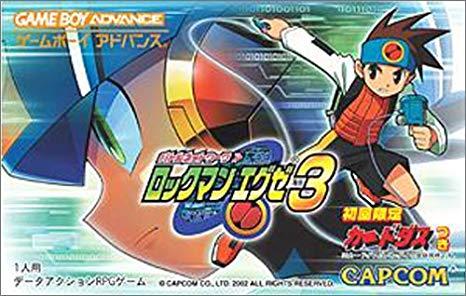
Battle Network Rockman EXE 3
バトルネットワーク ロックマンエグゼ3
Description
Mega Man Battle Network 3: White Version / Blue Version (GBA, 2002 JP / 2003 NA/EU): Tactical role-playing game developed and published by Capcom for Game Boy Advance. Third mainline game in Mega Man Battle Network series. Japan December 6, 2002 as Battle Network Rockman EXE 3 (single standalone version), Japan March 28, 2003 as Battle Network Rockman EXE3 BLACK (enhanced version with bug fixes, new areas, optional bosses), North America June 24, 2003, Europe July 4, 2003. Wii U Virtual Console: Japan December 17, 2014, North America May 14, 2015. Re-released Mega Man Battle Network Legacy Collection compilation 2023 (multi-platform). Japan Rockman EXE3 BLACK pre-released at World Hobby Fair events January 19, 2003, purchasable via mail-order.
Version differences: Japanese release model different from Western. Japan initially released single version (later White equivalent), then enhanced Black version months later. North America/Europe simultaneously marketed two complementary versions—White Version and Blue Version (Pokemon-style dual-release model). White based on Japanese original, Blue based on Japanese Black. Black contained same bugs White had despite enhanced status. Blue easier difficulty than White—FolderBack Giga Chip (easiest Giga Chip in Blue) strong enough altering battle approaches, restoring all used Battle Chips including itself promoting extra-aggressive playstyle. Award: Japan Rockman EXE3 won 6th CESA Game Awards Future for excellence (award given anticipated non-released works).
Setting: Parallel timeline to original Mega Man series—network technology flourished rather than robotics. Year 200X alternate timeline. World where Network Society dominates—people depend on internet for daily life, cyberspace accessible through devices called PETs (Personal Exploration Terminals—smartphone equivalent). NetNavis are A.I. programs living inside PETs assisting operators (Net Operators) with email, homework, money management, virus protection, hacking. Characters "jack in" to cyberspace battling computer viruses, hackers.
Story: Months after Netmafia Gospel attempted world takeover (Battle Network 2 events), virus-busting fifth-grader Lan Hikari and his NetNavi MegaMan.EXE return to ordinary lives until crime organization WWW (World Three) resurfaces. Simultaneously, NetBattle tournament N1 Grand Prix held—attempting find strongest NetBattler in Electopia, attracting neighboring countries. Lan/MegaMan pass preliminary rounds despite numerous WWW attacks seeking TetraCodes. Tournament revealed as WWW setup announcing their return. Lan/friends with Eugene Chaud's help piece together WWW's plan after attacks on ACDC School, Yoka Zoo—both hiding TetraCodes needed reviving monster Alpha (original internet prototype) for world takeover.
Dr. Wily (WWW head) moving behind-the-scenes in Gospel, creating copy Bass specifically for resurrection. Wily tricks true Bass removing final security measure on Alpha. Lan/MegaMan arrive, Alpha awakens. After battling Bass, Alpha devours Wily (via Pulse Transmission into Net) and Bass. Duo fights Alpha. Upon destruction, door appears leading Vision Burst of SciLab—Lan (also on Net) and MegaMan meet Tadashi Hikari (Lan/Hub's grandfather). Being only personality data, delivers encoded letter for Lan's father Doctor Yuichiro Hikari, remarks how Lan/Hub became great friends/brothers. Vision Burst within Alpha collapses. Before jack-out, Alpha captures Lan/MegaMan beginning devouring them—MegaMan sacrifices himself saving Lan. MegaMan thought deleted until Lan's father decoded grandfather's letter containing MegaMan's backup data and Tadashi Hikari's personality data, recovering/reviving MegaMan. Emotional climax involving themes friendship, sacrifice, family. Eight chapters with bosses. Side bosses certain chapters.
Gameplay core: Hybrid real-time/turn-based tactical RPG battling on 6x3 grid battlefield—player controls 3x3 side, enemies occupy opposite 3x3 side. Random virus encounters while moving through cyberspace (returned from original versus Battle Network 2's visible enemies) or scripted events. Battle halts action, special battle screen where viruses defeated (or fled using Escape chip) returning to cyberworld map. Real-time action selecting/using Battle Chips from customizable Folder (deck). Custom Screen appears—select up to 10 chips (initially 5, expandable via Custom Style) during brief pauses. Strategic deckbuilding collecting 300+ Battle Chips—offensive attacks, defensive shields, support abilities, elemental powers.
Major new systems:
Navi Customizer (NaviCust): Revolutionary customization program released by SciLab—Yuichiro Hikari chief developer. Players place NaviCustomizer Programs (NCP) into grid-based interface modifying MegaMan's stats/abilities. Tetris-like puzzle placing differently-shaped colored blocks. Programs enhance HP, attack power, defense, unlock abilities (auto-charge, super armor, elemental resistance). Color-coded system—Normal Style MegaMan runs white/pink/yellow NCP colors. Style Changes run additional color dependent on Style type—otherwise Error Code required. Incompatible colors cause errors—MegaMan won't boot unless remedied via Mod Code (sold by shady man Beach Street claiming from Netopia for 5,600 Zennys). Extra Code (EX Code) inputted if no incompatibility error—gives MegaMan extra abilities with some side effects. Compression command codes—programs reduced by few squares by holding Select, inputting sequence, allowing more programs inserted. Each program has unique compression code. System filed for Capcom patent July 2, 2002 (expired July 2, 2022). Strategic depth—buggy NaviCust powerful but risky, balanced NaviCust stable but limited. "11th Chip Glitch"—cursor on Custom Screen reaches 11th/12th/13th chip slot allowing impossible repeated chip access. Occurs running enough Custom1/Custom2 parts making Custom Screen exceed 10 chips. Capcom acknowledged glitch, banned opening beyond 10 slots in official tournaments. Glitch not fixed international releases.
Style Change system: Main transformation system. MegaMan receives first Style Change Chapter 3 virus battle against HeelNavis group. During battles, Action Points accumulate toward different Styles based on actions performed (using Buster, swords, elemental chips, avoiding damage, quick battles). Style with most accumulated points end-battle gives +1 Style Point. 100 battles required new Style (versus 280 previous games). Six Style types: Heat (Fire element—safe Lava panels, Flamethrower B PowerAttack), Aqua (Water element—won't slip Ice, AquaShot B PowerAttack paralyzing), Elec (Electric element—ZapRing B PowerAttack paralyzing), Wood (Nature element—HP recovery Grass panels, Twister B PowerAttack hitting 8 times, double hits Sand panels), Guts (Power type—doubled Buster Power, Guts Machine Gun rapid-fire, BreakCharge damaging guards, SuperArmor preventing flinching), Custom (Support type—extra chip slots Custom Screen, faster Custom Gauge). Each Style runs specific NaviCustomizer color avoiding errors. Styles level up completing battles unlocking stronger abilities.
PowerAttack damage not affected by buster stats but by WeaponLevel Navi Customizer Parts (up to Level 3). Two special Mega Chips usable if specific element. Bug Style—obtained using bugged NaviCust during Style Change. Only one Style kept at time besides Normal Style (previous games allowed keeping both). Mr. Famous with NetNavi Punk (Blue Version exclusive—Mega Man Killer from Game Boy platformers recognition). Punk's Battle Chip Japan-exclusive promotion but obtainable via cheat device/trading Black to Blue. White lacks Punk Navi.
Battle Chip classification expanded: Split into three categories unprecedented series-defining structure continuing all future entries. 200 white Standard chips (limited four each kind per folder even different letter codes), 85 blue Mega chips (limited five per folder, only one each kind—all Battle Network 2 Navi chips became Mega Chips preventing abuse like Full Custom exploited in predecessor allowed fives), 25 pink Giga chips (only ONE allowed per folder, only one copy each Giga chip exists entire game). Programs boost Mega/Giga chip limits. Five unique Giga chips exclusive each version (continuing future series—Battle Network 5 offers six per version). Program Advances—combinations three/four chips creating ultra-powerful attacks. 32 Program Advances total (second largest P.A. library to-date).
Balanced folder construction preventing overpowered strategies. Trading required attaining all seven stars—MistMan lacking Blue version, BowlMan lacking White version. "Comparing Libraries" option scans both players' libraries—if one has chip other lacks, other attains blank library spot representing chip. Chip buyable from Higsby's shop ACDC Town after defeating BeastMan using Order System. Giga Chips cannot bought Higsby's Shop.
Counter system: Time attack just right, enemy must die in process. Depending enemies countered, gain BugFrags for efforts (1 for 1 enemy, 3 for 2, 5 for 3, 10 for boss). BugFrags currency purchasing items/upgrading. Virus Breeder: Special friendly viruses (found somewhere Net) kept, fed BugFrags. When virus found/put in breeder, chip for virus obtained. Feeding viruses levels chip accordingly. After virus family fed maximum, release information where Omega Virus family located (strongest virus variant).
Multiplayer via Netbattling (Comm menu option): Practice (no chip loss risk, doesn't count Win/Loss record), Real (counts win-loss records, losing player forfeits random chip from pack). Special Giga-Chip attained this fashion (DeltaRayEdge Z for Blue, Balance Y for White)—1/32 chance instead winning player acquiring opponent's chip. Both players MUST have one+ star, battling midweight/heavyweight Real. Weight classes: Lightweight (level field, no negative panels), Midweight, Heavyweight. Trading Chips option. Folder customization strategic—30 chips selected from library, letter codes matching for combos.
Version-exclusive content differences: Color differences menus/objects—White standard building appearance (ACDC Town's squirrel statue always pink), Blue new color schemes buildings/objects (squirrel gold—color change prevalent later installments). Different standard Battle Chips unique codes per version. Shops different inventories. Contest Navi: BowlMan for Blue/Black, MistMan for White.
Unique Styles: GroundStyle/ShadowStyle (exclusive Battle Story Rockman.EXE manga versions not standard game). Cosmetic changes. Five exclusive Giga chips each version (DeltaRayEdge Z, FolderBack for Blue; Balance Y for White). Cannot trade Giga chips but Omega Navi Giga Chips actually duplicated. Both versions identical plots but distinct qualities.
Postgame content: Seven stars collectible title screen achievement. Holding Left D-pad Start screen, input code R R L R L R L L—stars move closer making room two more. 15 Omega Navis surface Net to fight, beating grants another star. Using Program Advance only usable with KingMan V5, BowlMan V5, or MistMan V5 finishes 32 Advances library granting star. First time final boss grows stronger after completing sidequests—Alpha evolves Omega form with new attacks, more HP after obtaining all stars (barring Program Advance star). Beating Omega Alpha, his Giga Chip obtained completely finishing game. Secret codes, hidden programs, extensive chip collection (300+ chips took players year+ collecting all—BugFrags grinding major time investment).
Length: 20-30 hours main story (extremely long GBA game—average Xbox/PS2/GameCube games ~30 hours), challenging but fair difficulty. Won't get tiresome though scavenger hunts might pause gameplay. Multiple gameovers expected. Riddles keep guessing, enemies keep fighting. Some complained too difficult versus predecessors—most difficult Network games. Others praised appropriate challenge. Backtracking/side missions criticized.
Audio: Reused tunes from previous games slightly changed fitting Lan Hikari's evolving lifestyle. Most memorable: ACDC Town (Lan's hometown five/six MegaMan Battle Network games). Music 8/10 according to fans—wished Battle song changed. GBA's limited sound chip somewhat muted versus console versions.
Graphics: "Pretty damn good for GBA game released 2003"—one of best games available GBA platform. Colorful engaging visuals. Character sprites well-animated. Cyberworld designs creative. 9/10 graphics according to user reviews. No graphics improvement versus Battle Network 2 (some effort lacking—no jack-in transmission animation, title screen doesn't animate). Main menu/key items menu praised as cool if monochrome. Adds feeling cyberworld (hospital level turning fire chips into fire burning obstacles—interesting if not great as Battle Network 2's riddles cracking codes).
Story incorporation: Took elements from Rockman.EXE/MegaMan NT Warrior manga (Pulse Transmission, Full Synchro) and anime (N1 Grand Prix, PET design). Crossover manga/anime/game continuity appealing fans. Great character development. Conspiracy plotline engaging mix serious/light-hearted moments. Easy finding yourself playing discovering what happens next. Dialogue typos criticized choppy places leaving players scratching heads. Some character lines hilarious ("rofl" moments). Storyline 9/10 despite wishing better ending.
Japanese sales: Strong commercial performance. Original version (December 6, 2002) second best-selling video game Japan release week—91,351 units (Famitsu). Appeared Famitsu top 30 best-sellers list twelve weeks following release—461,426 units sold by March 16, 2003. Black version (March 28, 2003) 11th best-selling video game Japan release week—28,708 units. Appeared Famitsu top 30 four following weeks—73,964 units by April 27, 2003. By end 2003: original version 500,001 units, Black version 168,946 units Japan alone. Combined total ~768,000 units Japan both versions.
Critical reception: Metacritic White Version 77% (based on 16 critic reviews—69% positive, 31% mixed, 0% negative). GameSpot 85/100—"If you've never navigated Battle Network before, third installment in sharp collect-and-battle series is great place to start." GMR Magazine 80/100—"If Battle Network 2 was tasty burrito, Battle Network 3 is tasty burrito stuffed inside larger, tastier burrito." Electronic Gaming Monthly 75/100—"If you can get past deja vu, you'll most likely have great time with BN3. Let's just hope next one offers something new." Nintendojo 70/100—"Story great, character development great, but gameplay elements can get little repetitive. Most difficult Network games." Nintendophiles 95/100—"Unlike anything I've ever played." NintendoWorldReport 85/100—"Conspiracy plotline great, good mix serious/light-hearted moments, quite engaging." Cheat Code Central 50/100—"If you've already played first two games, not much point playing this one."
User reception: Highly polarized. Metacritic White Version User Score 7.2 (based on 52 ratings—69% positive, 10% mixed, 21% negative). Passionate fans consider "best game all time," "favorite handheld game forever," "greatest handheld games ever," "one of best Mega Man games," "perfect score" titles. Common praise: incredible story/polished mechanics, fantastic hybrid real-time/strategy battle system spectacularly crafted, collecting never more fun/challenging, outstanding RPG elements/interesting characters, very lengthy with more-than-enough postgame content, variety Styles coming depending playstyle, unique/entertaining gameplay, risen handheld RPG standard Pokemon set with enjoyable/complex innovations. Viral chip collecting addictive—players spent months/years acquiring all chips. NaviCust great tool though frustrating times deciding programs. Critics note: too many chips collect (year+ collecting all, most BugFrags grinding), repetitive gameplay elements/backtracking, deja vu from previous games, declining freshness, story boring parts/choppy dialogue with typos, scavenger hunts felt rushed, little innovation over predecessors.
Legacy: Intended as finale Battle Network series—development Battle Network 4 started short while after release. Writer Masakazu Eguchi wrote last three mainline entries developers primarily focused evolving battle system from third game. Perfect distillation core gameplay principles making sub-series great—still holds up surprisingly well today. Established systems continued entire series: Giga/Mega/Standard chip classification, NaviCust customization, Style Change transformations, dual-version model (Battle Network 4 onward used Red Sun/Blue Moon, Battle Network 5 Team ProtoMan/Team Colonel, Battle Network 6 Cybeast Gregar/Cybeast Falzar), Program Advances, BugFrag collecting, Virus Breeder. Demonstrated viability tactical RPG departing classic action platformer while delivering colorful engaging gameplay experience—by far most memorable Mega Man RPG attempt.
Created Masahiro Yasuma (series creator), inspired by success Nintendo's Pokemon series alongside rise collectible card games—Battle Chips designed evoking trading card mechanics. Sequel Mega Man Battle Network 4 released December 2003 Japan, June 2004 North America involving meteor trajectory Earth, new crime syndicate "Nebula" corrupting Navis with Dark Chips.
Multimedia adaptations: MegaMan NT Warrior anime series premiered Japan March 4, 2002, concluded September 30, 2006—209 episodes lasting five series (EXE, Axess, Stream, Beast, Beast+). English dub handled Viz Media (only EXE/Axess dubbed). Film Rockman.EXE the Movie: Program of Light and Darkness premiered Japanese theaters March 12, 2005 (Stream era)—double-billing with Duel Masters film, grossed $6,178,840 within three weeks.
Enduring appeal: Considered by many series' peak—BN3 having "incredible story/polished mechanics," BN6 having "most refined/balanced combat." Debates continue whether BN2 or BN3 superior (some prefer BN2's freshness, others BN3's depth). Frequently cited among best GBA games, best tactical RPGs handheld, definitive Mega Man spin-off. Mega Man Battle Network Legacy Collection (2023 multi-platform) brought entire series modern audiences—Volume 1 contains Battle Network 1-3, Volume 2 contains Battle Network 4-6. Legacy Collection praised fantastic rerelease, definitive experience new/returning players. Online play making mastering games together best they've ever been. Compilation disappointed not correcting poor translation errors English ports (especially BN4 egregious). Addressed game bugs/crash issues cartridges had.
Cult classic among tactical RPG enthusiasts, Mega Man fans valuing unique departure from platforming roots. Proven template tactical RPG/deck-building hybrid influencing future games. Demonstrated handheld capable complex strategic depth rivaling console experiences. Established Battle Network as viable standalone franchise separate from Classic Mega Man—total six mainline games plus spin-offs (Mega Man Network Transmission GameCube 2003, Mega Man Star Force Nintendo DS trilogy spiritual successor). Series sold millions copies worldwide cementing place Mega Man legacy alongside Classic, X, Zero, ZX, Legends sub-series.
What Members Paid (Anonymous)
No member purchase data available yet. Be the first to add this game to your transactions!
Shopping Assistant
Use our AI-powered shopping assistant to find Battle Network Rockman EXE 3 across multiple online marketplaces including eBay, Mercari, Amazon, and more.